 |
Detail from The Enraged Macaroni, 1773; Lewis Walpole Library
Aprons: Practical, functional, and fashionable
There has been a lot of discussion about aprons lately on social media. There are great resources available for viewing original aprons and even websites that provides a wealth of information such as http://www.larsdatter.com/18c/aprons.html
So, what is the point of my blog article. Well, mine is solely on the types of aprons that are found in the estates of women and their spouses in North Carolina. By looking at the inventories, wills, and then corresponding it with newspapers advertisements for goods imported, runaway ads and etc., we come to the conclusion that aprons were a staple in a woman's wardrobe during the 18th century. Not only as a practical item of clothing but they also could serve as a fashionable piece as well. It was common for women to have both check'd aprons and white aprons in their wardrobe.
In the 89 inventories and wills of both women and their spouses who resided in North Carolina from 1738-1783, I have found (and I keep finding more) there were 230 aprons listed. That is a average of 2.5% aprons per estate.
There are some estates that skew the numbers like the 1748 inventory of the Green estate of Edgecombe County, North Carolina which lists 23 aprons - 14 linen, 1 short apron worsted and 8 aprons.
Another inventory that skews the numbers is Mary Brewton's. She has 18 aprons.
 |
| Mary Brewton's estate in New Hanover County, North Carolina lists 11 fine and 7 coarse aprons. |
Mary Coen of Pasquotank County had 16 aprons listed.
Elizabeth Hanner also of Pasquotank County had 11 aprons
Rachel Hill's inventory in 1763 lists the most variety of aprons in all the inventories that I have found.

2 1/2 worn check't aprons, 3 old check't ditto; . . . 1 new white holland apron; 1 1/2 worn garlix ditto; 1 1/2 worn muslin ditto, 1 old ditto, 1 1/2 worn check't apron.
Another 2 inventories of interest that have a variety of aprons listed are Sarah Prichard of Burke County and Amelia Mott of New Hanover County.
Sarah had 1 black crape, 1 check apron, 2 linen aprons in her 1768 inventory.
While in 1771, Amelia had 1 old check apron, 1 check apron, 1 white apron and 2 aprons. If they bothered to describe the check and white apron what makes the other "2 aprons" different?
What makes it frustrating when researching is when they only list the items in the inventories or sales of the estate, they only list x amount of "aprons" but do not describe or list the type of textile.
Here is the math and breakdown of percentages of aprons
63% "apron" or 146 aprons
7% linen or 17 aprons
7% check or 16 aprons
5% white or 11 aprons
5% fine or 12 aprons
3% coarse or 7 aprons
3% muslin or 4 aprons
The rest are either 1% or less which are:
Garlix: 2 aprons
Old: 3 aprons
Silk: 2 aprons
Cotton: 2 aprons
Holland: 2 aprons
Lawn: 1 apron
"Gause" flowered: 1 apron
Flowered: 1 apron
Worsted: 1 apron
Black Crape: 1 apron
However what I am not finding are "blue" aprons. I have one reference for a runaway in Charleston in 1783 but they do not show up in any inventories or wills in North Carolina. So, one could speculate that this is a New England/PA/MD regional item. They do show up in English newspapers for runaways or stolen items.
Sarah had 1 black crape, 1 check apron, 2 linen aprons in her 1768 inventory.
While in 1771, Amelia had 1 old check apron, 1 check apron, 1 white apron and 2 aprons. If they bothered to describe the check and white apron what makes the other "2 aprons" different?
What makes it frustrating when researching is when they only list the items in the inventories or sales of the estate, they only list x amount of "aprons" but do not describe or list the type of textile.
Here is the math and breakdown of percentages of aprons
63% "apron" or 146 aprons
7% linen or 17 aprons
7% check or 16 aprons
5% white or 11 aprons
5% fine or 12 aprons
3% coarse or 7 aprons
3% muslin or 4 aprons
The rest are either 1% or less which are:
Garlix: 2 aprons
Old: 3 aprons
Silk: 2 aprons
Cotton: 2 aprons
Holland: 2 aprons
Lawn: 1 apron
"Gause" flowered: 1 apron
Flowered: 1 apron
Worsted: 1 apron
Black Crape: 1 apron
However what I am not finding are "blue" aprons. I have one reference for a runaway in Charleston in 1783 but they do not show up in any inventories or wills in North Carolina. So, one could speculate that this is a New England/PA/MD regional item. They do show up in English newspapers for runaways or stolen items.
Ready Made Goods and Imported textiles
By looking at ready made goods and imported textiles in both North and South Carolina this gives researchers a glimpse of what was available during the 18th century. Consumerism was key especially in port cities like Wilmington and New Bern, North Carolina and then Charleston, South Carolina. It is key in the back country as well. Goods are going inland to stores in areas like Cross Creek, North Carolina and to Cheraw, South Carolina.
I included South Carolina in this post as the newspapers for SC from 1750-1770 have become available for viewing, which is great for researchers.
The following ads show specific textiles that are being sold for the manufacture of aprons and then also "ready made" accessories such as aprons.
I included South Carolina in this post as the newspapers for SC from 1750-1770 have become available for viewing, which is great for researchers.
The following ads show specific textiles that are being sold for the manufacture of aprons and then also "ready made" accessories such as aprons.

"Gauze aprons, handkerchiefs and ruffles" to be sold at William Watkins store in Wilmington, The North-Carolina Gazette, Wilmington, North Carolina: 26 Feb 1766

Ready made "worked Muslin and Lawn Aprons" and"Gauze Aprons" for sale in Charleston, SC 1771. The South-Carolina and American General Gazette
Charleston, South Carolina : 17 Jun 1771, Mon • Page 4
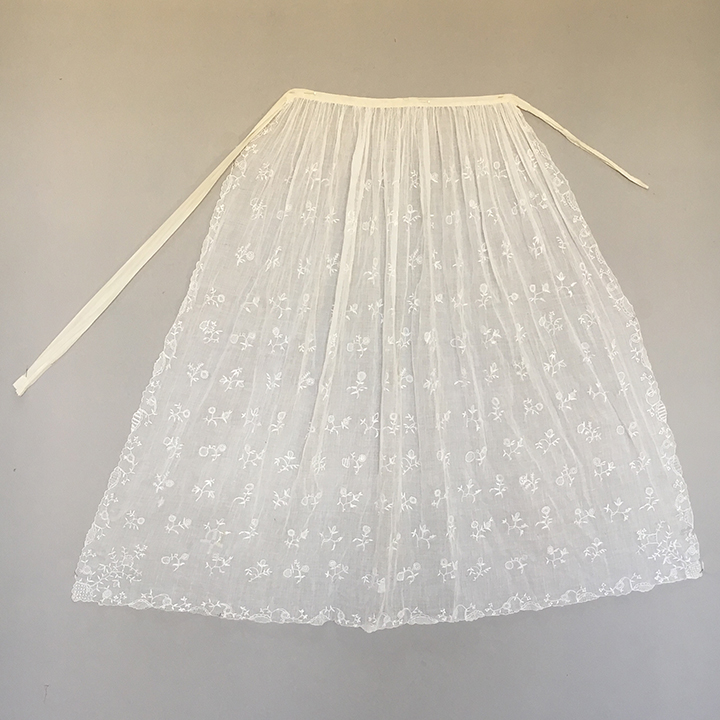 |
| Listed on Meg Andrews 1770-1790 the fine muslin tambour embroidered throughout with rows of white cotton single and double flower sprigs, each 5 cm high, with twelve different designs, the lower corners with stylsied flowerhead surrounded by tendrils and leaves emerging from a drawnthreadwork rocky mound, the borders with gently scalloping with curving flower stems and cartouche infills, Drop 38 1/2 in/ 98 cm drop. Hem width 50in/1.27 cm. |
Here is a few advertisements for ready made aprons and the prices they are being sold for in South Carolina.
 |
| "The South Carolina and American General Gazette" November 4, 1771: Charleston, SC What I like about this advertisement is that they are willing to take deer-skins as payment for any of the above goods. |
 |
| "The South Carolina Gazette" June 7, 1773 Charleston, SC |

