Showing posts with label textiles. Show all posts

Thursday, March 18, 2021

"Done with these Worldly Goods and a Posterity to bestow them upon" - Examining inventory records of New England versus Southern records


Recently I had a chance to look back at some genealogy work that I had done.  This time trying to find inventory records of my female ancestors which in some cases is hard to do.   Out of all my Germanic relatives, I have a sliver of ancestors who lived in the Colonies during the 1600 and 1700s.  So I had this brainy idea to compare my New England relatives with my southern ones, the ones living in Virginia mostly.   Needless to say if you are looking for Massachusetts records, good luck.  I found most of my records available in Connecticut via Ancestry.com.   So without finding any Virginia relatives records (at this current time), I am going to compare a couple of Connecticut inventories with some North Carolina inventories by years.  


We are starting with Susannah Knowlton Olcutt who dies in East Haddam, Connecticut in 1754  - she is my 8th great grand aunt.  So finding this inventory made me super happy.  Her husband, Cullick Olcutt (my uncle) died in 1732 right before the birth of their last son Benjamin. 


In 1754, she leaves her three children her worldly possessions, Thomas, Benjamin and Hannah.  Ironically, her daughter does not receive the bulk of her clothing, only a few items.  

Thomas receives the following clothing items: one silk crape frock; and one blew (blue) shaloon quilt (quilted petticoat?) and one Black bonnet.  

Benjamin receives one pare of stays and one gown and one pare of gloves and one white Holland apron; one lutestring hood, one piece of green plain cloth and one piece of black and blue plain cloth and one little trunk and one fan and six Holland caps … one linnen patecoat (petticoat).

While Hannah Olcutt Fisher only receives one linen shift and two woolen westcots (waistcoats); two aprons and two linen caps.

The items were appraised per the law direct in 1754.   The quilted petticoat, gown and bonnet was appraised at 3 pounds;18 shillings. And then other items such as the stays, quilt, one cote, aprons, shifts, waistcoats, handkerchiefs, silk hood are all listed and appraised. 
___________________________________________________________________________________

Then we look at the inventory of Hannah Charles of Perquimans County, NC.  Her probate is processed in 1753.   Not much is known about her but what makes her interesting is that she has jackets listed in her inventory.   It is a possibility that she was a Quaker since there were a large contingent of Quakers living in northeast North Carolina in the early 1700s. 


Estate Record of Hannah Charles, Perquimans County NC 1753


Hannah has 1 old camblet mantle, 1 old woolen jacket, 5 homespun petticoats, 1 cotton jacket, 2 pare of stockings, 1 stuff quilted petticoat, 3 homespun petticotes, 2 garlicks shifts, 6 aprons, 4 fine caps, 1 check'd handkerchief, a half yard of homespun, 1 pare of pockets, (further down) a pocket, 1 pormester hat, 1 basket and then finally 1 pair of linen gloves.

The thing to notice are two things, one the presence of jackets and the lack of bonnets in Hannah's estate.   The jackets are found in Quaker inventories in the northeastern part of North Carolina.  The lack of a bonnets strikes me but bonnets are found in the Carolinas.  Interestedly enough she has a a pormester hat which I am guessing is a straw or wool hat. 

___________________________________________________________________________________

Now we go back to Connecticut to look at the estate of Dr. Samuel Ely of Durham, CT; he dies in 1755.  Within his estate there are several pieces of women's clothing.  As much as we would like to only look for women's estate records, in many cases, we need to look at the spouses' estate records as well.   This is a possible relative but haven't been able to track down for certain.

Estate of Dr. Samuel Ely of Durham, CT, December 24 1755


Estate record of Dr. Samuel Ely of Durham, CT 1755


I love the variety of clothing listed in this inventory.  His wife was Sarah as listed in a previous document.  More than likely she died shortly before he did.  

1 pair of stays which was worth 1-6-8 (1 pound, 6 shillings and 8 pence) those are some expensive stays in the 1750s.  But we will look at those again in a little bit after doing a little bit of digging.

1 silk crape gown; 1 black and white chintz gown, 1 calico gown, 1 striped gown, 1 pr women's stockings, 1 pr ditto; 1 green skirt; 1 red cloak, 1 velvet hood, 1 muslin apron; 3 shifts; 1 lawn handkerchief, 1 holland ditto; 1 pair ruffles; 1 lawn cap; 1 lawn cap; 2 caps; 2 cap ribbons; 1 pr shoe buckles; 1 fan; 1 silk damask blanket; 1 pair gold jewels (earings?); 1 gold ring.

What I like about her inventory is the variety of gowns listed.  Silk, chintz, calico and a striped gown of unknown fabric more than likely linen I am guessing.  Also we see lawn being used as a textile for handkerchiefs, caps and then a muslin apron.  Little bits and pieces of textiles being used to elevate a person's status.  Not insanely rich but well off nonetheless.


Here is another version of the items listed in the inventory from another document.  It is attached to Dr. Ely's will.  Which I find interesting is that the stays are valued at a much lesser price of 26/8 (26 shillings, 8 pence). Also listed is what looks like a "hat" listed right before the lawn handkerchief.  This item was missing from the previous inventory taken.  And the striped gown is identified as being linen which helps us understand Mrs. Samuel Ely's wardrobe.

___________________________________________________________________________________

   Back in North Carolina....this time we examine the inventory of  Widow Rachel Mugaridge of New Hanover County from 1759.  More than likely, she lived in or near Wilmington, North Carolina. Here we see bed gowns and a "check" bonnet listed  among other items.  "Check" bonnets seem to definitely be a unique item in North Carolina.  The only other place that I  have found "check" bonnets listed is in Maryland, (1750s-60s) in runaway advertisements.  I have yet to find "check" bonnets mentioned anywhere else.


Inventory of Widow Rachel Mugaridge, New Hanover County, North Carolina 1759


What I find interesting about here inventory is that variety of clothing listed.  A silk gown, a calico gown along with 2 bedgowns.  Could the bedgowns considered a lesser item or a dress down item from the gowns, possibly.  Also are the "quilts" quilted petticoats?  They are listed alongside the "under petty coat", which again....what does that mean?


___________________________________________________________________________________


"Connecticut Journal" January 26, 1770 page 4


Here we see an advertisement for the estate of Sarah Granger, late of New Haven, Connecticut in 1770.  Again, a possible relative but haven't tracked her down yet.  Her inventory is interesting because we find a few things...


Above we see one stript gown old; one short gown? ; one quilt old shalloon? ; one quilt flannel old?; 2 old caps; one old sheet wore out and --- old check linen apron.


 Then on the 2nd page we see one old black silk hood and one old short cloak.   I would categorize her as a lower class person.  Her total estate was only worth 14 pounds.  What I find interesting is you don't see stays, shoes, shifts, hats or anything extra in her wardrobe.  I am guessing she was more than likely she was buried with them.
___________________________________________________________________________________

Next we examine the estate records of Sarah Wilson of Bertie County, North Carolina.  The inventory of goods and chattel were taken on March 20th 1770.  I had recently found this inventory while looking through some other records.   Bertie County is located in northeast North Carolina and was established as a county in 1739.   

Her inventory is interesting because she has 2 bonnets, a "permeter" hat, "shift's cloth" and a variety of other things too.   Of her bonnets, she has a white and a black bonnet listed.   Would the white bonnet be used in the summertime while the black bonnet is used during other times of the year?   


I like that the handkerchiefs are mentioned as either silk or just handkerchiefs.  You wonder if those 5 handkerchiefs were printed in some manner or not.  Again, another jacket is listed in her inventory.  I do not know if Sarah was a Quaker or maybe some other ethnic group. More to look into I suppose.  I love her inventory, I just wish there was more descriptions of her gowns and clothing but alas it's another story to look into.
___________________________________________________________________________________

And then my final inventory...Beluah Holmes of Woodstock, Connecticut.  She dies in 1778.  She was only 48 years old when she passed.  Her wardrobe is amazing.  She never married and her mother Hannah had died the previous August.  Again another possible relative but haven't traced it down for certain.  What I love about her inventory is the variety of clothing and that she has "short" gowns listed in her inventory but yet she is 48 when she passes away.  So does the rule that "short" gowns are only found on younger women seems a little bunk.   


She has 2 short gowns listed - a linen and a striped short gown. Again she is no spring chicken but what do short gowns exactly mean in the 1770-80s?  More goodies to dive into such as she has quilted petticoats, brown mitts, linen gloves, a black silk bonnet, cotton and linen stockings, and then the waistcoats.  Were the waistcoats used for informal wear like around the house instead of wearing stays?   She has 2 waistcoats and then a striped woolen waistcoat but she does have 1 pair of stays.  

 Oh her gowns.....
1 crimson silk & worsted; 1 purple and white chintz; 1 double wrapping? gown; 1 brown camblet gown; 1 white corded dimmothy (dimmty) gown.   What shocks me the most is that her cambrick apron was worth 42p which is almost the same price as one of her gowns.  I just love this inventory.  So many ideas for a woman to wear in New England in the late 1770s.  

Looking at inventories always gives me ideas for my impression.   Maybe I will recreate some of the items listed in the estate records of my relatives as my way of honoring them.   I am really loving the purple and white chintz gown....(Ideas are brewing).......

Thanks again for checking out my blog.   Till next time.  Keep researching and always ask questions!

Friday, February 14, 2020

"Check your Aprons: Fashion and Function in a Common Object"


 Detail from The Enraged Macaroni, 1773; Lewis Walpole Library


Aprons: Practical, functional, and fashionable


There has been a lot of discussion about aprons lately on social media.  There are great resources available for viewing original aprons and even websites that provides a wealth of information such as http://www.larsdatter.com/18c/aprons.html 

So, what is the point of my blog article.  Well, mine is solely on the types of aprons that are found in the estates of women and their spouses in North Carolina.  By looking at the inventories, wills, and then corresponding it with newspapers advertisements for goods imported, runaway ads and etc., we come to the conclusion that aprons were a staple in a woman's wardrobe during the 18th century. Not only as a practical item of clothing but they also could serve as a fashionable piece as well.  It was common for women to have both check'd aprons and white aprons in their wardrobe. 

In the 89 inventories and wills of both women and their spouses  who resided in North Carolina from 1738-1783, I have found (and I keep finding more) there were 230 aprons listed.  That is a average of 2.5% aprons per estate.  


There are some estates that skew the numbers like the 1748 inventory of the Green estate of Edgecombe County, North Carolina  which lists 23 aprons - 14 linen, 1 short apron worsted and 8 aprons.

Another inventory that skews the numbers is Mary Brewton's.  She has 18 aprons. 


Mary Brewton's estate in New Hanover County, North Carolina lists 11 fine and 7 coarse aprons. 


Mary Coen of Pasquotank County had 16 aprons listed. 
Elizabeth Hanner also of Pasquotank County had 11 aprons


Rachel Hill's inventory in 1763 lists the most variety of aprons in all the inventories  that I have found.


2 1/2 worn check't aprons, 3 old check't ditto; . . . 1 new white holland apron; 1 1/2 worn garlix ditto; 1 1/2 worn muslin ditto, 1 old ditto, 1 1/2 worn check't apron.


Another 2 inventories of interest that have a variety of aprons listed are Sarah Prichard of Burke County and Amelia Mott of New Hanover County.

Sarah had 1 black crape, 1 check apron, 2 linen aprons in her 1768 inventory.   

While in 1771,  Amelia had 1 old check apron, 1 check apron, 1 white apron and 2 aprons.    If they bothered to describe the check and white apron what makes the other "2 aprons" different?  

What makes it frustrating when researching is when they only list the items in the inventories or sales of the estate, they only list x amount of "aprons" but do not describe or list the type of textile.  

Here is the math and breakdown of percentages of aprons 

63% "apron" or 146 aprons 
7% linen or 17 aprons
 7% check or 16 aprons 
 5% white or 11 aprons
 5% fine or 12 aprons
 3% coarse or 7 aprons
3% muslin or 4 aprons

The rest are either 1% or less which are: 

Garlix: 2 aprons
Old: 3 aprons
Silk: 2 aprons
Cotton: 2 aprons
Holland: 2 aprons
Lawn: 1 apron
"Gause" flowered: 1 apron
Flowered: 1 apron
Worsted: 1 apron
Black Crape: 1 apron

However what I am not finding are "blue" aprons.  I have one reference for a runaway in Charleston in 1783 but they do not show up in any inventories or wills in North Carolina.  So, one could speculate that this is a New England/PA/MD regional item.   They do show up in English newspapers for runaways or stolen items. 


Ready Made Goods and Imported textiles


By looking at ready made goods and imported textiles in both North and South Carolina this gives researchers a glimpse of what was available during the 18th century.   Consumerism was key especially in port cities like Wilmington and New Bern, North Carolina and then Charleston, South Carolina.   It is key in the back country as well.  Goods are going inland to stores in areas like Cross Creek, North Carolina and to Cheraw, South Carolina.


I included South Carolina in this post as the newspapers for SC from 1750-1770 have become available for viewing, which is great for researchers.  

The following ads show specific textiles that are being sold for the manufacture of aprons and then also "ready made" accessories such as aprons.


"Gauze aprons, handkerchiefs and ruffles" to be sold at William Watkins store in Wilmington, The North-Carolina Gazette, Wilmington, North Carolina: 26 Feb 1766


Ready made "worked Muslin and Lawn Aprons" and"Gauze Aprons" for sale in Charleston, SC 1771.  The South-Carolina and American General Gazette

Charleston, South Carolina : 17 Jun 1771, Mon  •  Page 4


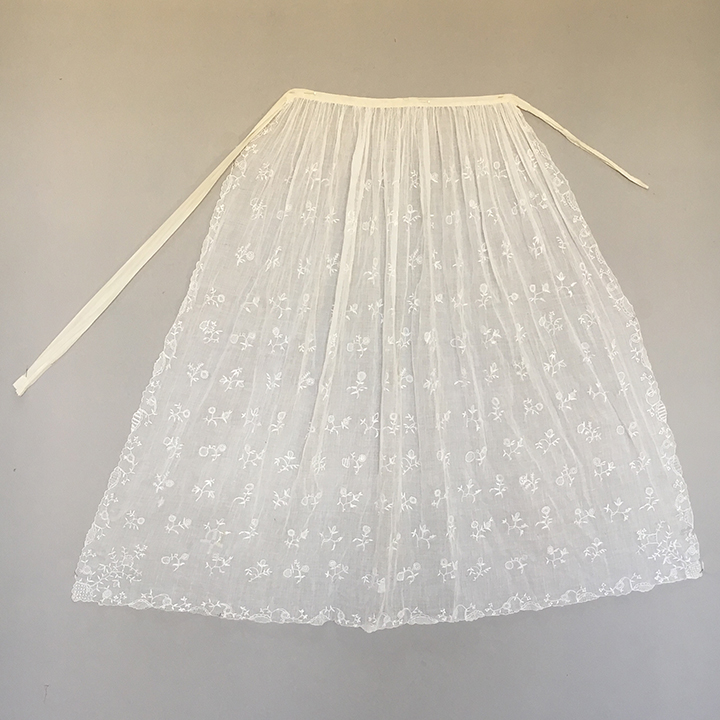
Long Apron
Listed on Meg Andrews 1770-1790
the fine muslin tambour embroidered throughout with rows of white cotton single and double flower sprigs, each 5 cm high, with twelve different designs, the lower corners with stylsied flowerhead surrounded by tendrils and leaves emerging from a drawnthreadwork rocky mound, the borders with gently scalloping with curving flower stems and cartouche infills,
Drop 38 1/2 in/ 98 cm drop. Hem width 50in/1.27 cm.


Here is a few advertisements for ready made aprons and the prices they are being sold for in South Carolina.

"The South Carolina and American General Gazette" November 4, 1771: Charleston, SC
What I like about this advertisement is that they are willing to take deer-skins as payment  for any of the above goods.

"The South Carolina Gazette" June 7, 1773  Charleston, SC

Friday, February 22, 2019

Dreary Days of Winter

The roller coaster weather here lately makes it hard to plan what to pack for an upcoming event.  Will a linen gown be suffice or should I pack my new mixed indigo blue worsted gown that I made?  This mixed indigo is from Burnley & Trowbridge.  I loved how it draped and it has a nice light but warm feel to it. 


So, looking at the inventories, what was available for women to stay warm on these damp and cool days.  There was a variety of textile available for women to make gowns out of during the 18th century.  Callimanco, Duroy, Crape, Camblet, Stuff, Saggathy, Grazet and Worsted are all mentioned in the estates of women in North Carolina as a textile for gowns.

Mary Stubbs in 1738 listed a callimanco gown among others in her inventory.  The Dreamstress has a great article about what exactly is callimanco.   Callimanco is defined as "a worsted 'stuff' . . . [with]a fine gloss upon it.  Callimancos are of all colours, . . .some are quite plain, and other have broad stripes, adorned with flowers, some with plain broad stripes, some with narrow stripes, and other watered. (Montgomery, 185).  Unfortunately, there are no vendors currently carrying callimanco in their stores.  Maybe that will change.

Then we come across the textile Duroy in the inventories of Mary Glouster/Glaister in 1740 and in Elizabeth Montague's 1756 inventory.  Note both of these ladies were early Quaker settlers in the northeast portion of North Carolina.  Duroy is a "lightweight worsted material generally used for men's clothing." (Montgomery, 230).  However in the case of Elizabeth Montague, she specifically said for duroy to be purchased from her estate to make the gown.  
"Item.  I give to Naomy Newby wife of James Newby, Duroys for a gound to be bought from my Estate."
Elizabeth Montague's will 1756, Perquimans County, North Carolina

Crape gowns are mentioned in three inventories: Elisebeth Handcock (1743 Craven County); Alice Whitehead  (1743 Craven County); and Elizabeth Montague (1756 Perquimans County).  Crape is defined as " a light transparent stuff, in the manner of gauze, made of raw silk, gummed and twisted on the mill; wove without crossing and much used in mourning."  Other crapes were made of worsted and sometimes mixed with silk. (Montgomery, 207).  I am guessing these three are the worsted types since they do not list them as "silk crape" like in the inventory of Lawrence Mague (1740 Bertie County) that lists a silk crape gown and coat. (probably his late wife's.)


Imported good from Samuel Cornell in Newbern, NC 1764.   "The Newbern Gazette" 02 November, 1764 (Newspapers.com)

Camblet gown is listed in Anne Pollard (1750 New Hanover County).  Camblet example from Burnley & Trowbridge.  I actually have a bedgown completed and a gown cut out to be made from their Camblet.  Camblet was very popular for clothing during this time.  Numerous runaway advertisements in newspapers list camblet or camlet gowns being worn all up and down the East Coast.  We also see camblet imported and sold in North Carolina at the store of Samuel Cornell of New Bern, NC.  


Margaret Prichett bequeathed a stuff gown to her "grand daughter Margaret Prichett"  Interestingly enough, this gown is absent from another version of the will.  No color description of the gown but nonetheless, a woolen gown can be very warm on a damp winter day.

Will of Margaret Prichett (1756 - Beaufort County)


Inventory of Rachel Hill (1763 Carteret County)


The inventory of Rachel Hill is very interesting on several levels.  Of her six gowns she has in her estate, two are of a woolen material.  "Saggethe" and "Grapset".   

Saggathy is listed as "a slight woolen stuff of twill weave, a kind of serge or ratten sometimes mixed with a little silk." (Montgomery, 337)  As you notice in the list of imported goods in Samuel Cornell's store, saggathie is listed.  I have seen other references to saggathy in North Carolina.  

Grapset or Grazet is similar material. Grazet can be found as early as 1732 in Pennsylvania.  What is interesting about Rachel's inventory is that there is a gown, petticoat and a bonnet all made from grazet. 


And then we round out the list of woolen gowns with Ann Eborn's estate in 1769 of a "worsted gown"


So when you are trying to decide on if a woolen gown is appropriate in the south, the answer is yes.  If you notice that all of these textiles are considered a "lightweight" and not a heavy wool like say serge, broadcloth or etc.  I don't think you could make a gown out of something of a heavy material.  Plus living and working on the water, there are many days that the temperatures are 10-15 degrees cooler than up in "town."   Even in the late spring, you could still comfortably wear a woolen gown based off of experimental archaeology.   Have a great weekend!


References: 

Textiles in America, 1650-1870: A Dictionary Based on Original Documents, Prints and Paintings, Commercial Records, American Merchant's Papers, Shopkeepers' Advertisements, and Pattern Books with Original Swatches of Cloth by Florence Montgomery.


If you don't have this book - I highly recommend getting a copy somehow.  It is the bible of historical textiles.