Showing posts with label NC history. Show all posts

Wednesday, January 7, 2026

What are men actually wearing in the Carolinas?

 Men's clothing sometimes can be easier to find than women's clothing when examining estate and inventory records in the 1700s.   Earlier in the period, clothing is listed more frequently but by the 1770s, household or trade goods are listed more often than clothing. In this post, I will examine men's clothing listed in estate and inventories from the following counties; Duplin, New Hanover and Cumberland, North Carolina.  

John Matchet, 1774 Duplin County, NC inventory of estate


John Matchet lived in Duplin County, NC and his inventory from his estate listed the following clothing items:  2 hats, 4 coats, 5 jacket, 3 pairs of breeches, 1 pr of trousers, 5 shirts, 2 prs of stockings, 1 pair of Indian boots, 1 pair of shoes and buckles, 1 silver shoe buckle, 1 pair of knee buckles, 1 stock buckle, 2 razors and 1 watch


Not much description of the textiles of his clothing but as you can see he has both coats and jackets and breeches and trousers.   One thing to note is the Indian boots.   I have seen these mentioned in other inventories like in A Holden's estate in 1774 again from Duplin County.   Are these moccasins or a boot that you would wear while hunting?


Maurice Nevin, 1767 New Hanover County, NC inventory of estate


Next we have Maurice Nevin of New Hanover County who estate was inventoried in 1767.  Again we see 2 coats, 2 pairs of breeches, 2 jackets, 3 pairs of Hose, 4 shirt, 2 handkerchiefs, 1 hat, 1 pair of shoes, 1 pair of silver buckles.    Are the 2 coats actually long bodied coats or are they waistcoats?  As there are no waistcoats listed in this inventory.   Also, the word hose is used instead of stockings.   Is this traditional hose or just a term used by the person carrying out the inventory?  Also note the 2 muskets and pistol listed at the top. 


Here we have the inventory of James Steele of Cumberland County in 1774.   He has 2 coats, 3 jackets, 1 pr of leather breeches, 2 prs of plush breeches, 1 pr of thread hose.  Down at the bottom of his inventory they list 2 coats and 2 prs of breeches


James Steele, 1774 Cumberland County, NC inventory of estate


Another 4 coats are listed but I wanted to point out that Mr. Steele was a freemason.  As he has 1 freemason apron, 1 pr of white gloves and a 1 T-- Wigg in his inventory.   Again, note razors, strops and shaving boxes listed in his estate.   I have seen other freemason items listed in a few other inventories across North Carolina.


Andrew Gunderson, 1774 Cumberland County NC inventory of estate


Here we have Andrew Gunderson's inventory and they list the following items.  1 old blue jacket, 3 old pairs of trousers, 2 old ozenbrig shirts, 2 old linen shirts, 1 old stamped jacket, 1 old pair of shoes, 7 shillings of Proclamation money.

Not much here but the two types of shirts, ozenbrig and linen. a blue jacket and a stamped jacket?  We find stamped fabric for women's clothing but for men's?   Would this maybe be a banyan of stamped linen or just a typical jacket?  


Richard Beaughan's inventory, 1771 Cumberland County NC


So here at Cross Creek, NC in Cumberland County we have the inventory of Richard Beaughan. 1 blue coat trimmed in silver buttons, 1 camblet coat, 1 surtout coat, 1 red jacket, 1 pr of doe skin breeches, 1 pr of shoes, 4 shirts, 1 pr of copper shoe buckles, 1 pr of silver knee buckles, 1 pr of sleeve buttons, 1 hat,

In this inventory we see a little bit of description of the clothing, blue coat with silver buttons and a red jacket and the copper shoe buckles.  This is the first time I have seen doe skin breeches listed.  Normally we see leather breeches noted in inventories and that is something I will go into for a later blog post. 


Inventory of James Bradley 1771 New Hanover County, NC


I'll conclude with this inventory of James Bradley who was a merchant in the Wilmington area.  His inventory is broken down into saleable goods like textiles and products that would be sold in his store and also furniture in his house.   

11 shirts, 14 cravats, 7 linen waistcoats, 7 prs of thread stockings, 6 nightcaps, 2 prs of nankeen breeches, 1pr of ticken breeches, 1pr of sheets, 4 coats & waistcoats, 2 prs of breeches, 1 camblet cloak, 1 pr of silver shoe and knee buckles, 8 tortoise shell jacket buttons, 1 pr of broken Scotch Pebble sleeve buttons, 1 silver watch, 1 wig and wig box and 1 hat.   The tortoise shell jacket buttons are interesting as well as the broken scotch pebble sleeve buttons.  Wonder what those looked like?

Thanks for checking out the blog.   What would you like to see more of?   Leather breeches, fancy coats and waistcoats listed?    There is more to explore and there is some amazing clothing in the Carolinas during the 18th century for sure. 

Thursday, November 12, 2020

Imported and domestic knitted goods (Part Two)

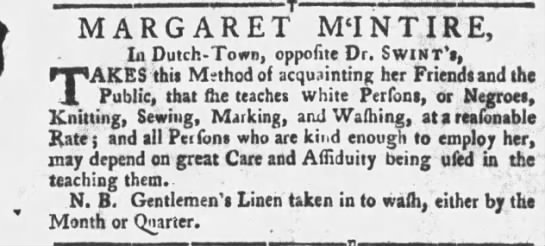
Margaret McIntire - teaches knitting, sewing, marking and washing 1770 in Dutch Town - SC -
The South Carolina Gazette and Country Journal (Charleston SC)- June 26 1770

Part Two of my research for imported and domestic knitted goods, I examine the types of knitting needles listed among inventories, invoices and store ledgers; how common were yarn stockings and finding advertisements to teaching people how to knit.  Also the types of stockings listed in women's inventories in North Carolina.

I am sure not the entire population of women during the 18th century knew how to knit.  It was a cottage industry in many areas of the world.   So the myth that everyone knitted or made their own stockings or knitted goods, is well untrue.  Ready made goods were available and imported from overseas or even within the colonies, there are advertisements posted to teach others how to knit and knitting needles were imported and sold in stores.  I don't find darning eggs listed in among items in women's inventories or as a ready made good/item.  


Out of the hundreds of women's inventories, only four list knitting needles among their possessions.  There is a 1750 sale of a man's estate that list several pairs of knitting needles as well   I might need to revisit the inventories again to look into more detail but my earlier notes I did list them as something of interest as I am a knitter myself.  

The 1762 inventory of Sarah Collings in Pasquotank County, North Carolina lists yarn, 2 pr of "nitten" needles and half a stocking (underlined in blue).  What does 2 pairs of knitting needles mean?  Most knitted items were knitted in the round on 4 needles and then a 5th needle as the working needle.  So does this mean 10 knitting needles in total?  

"North Carolina Estate Files, 1663-1979," Pasquotank County; Collings, Sarah (1762); State Archives, Raleigh.

The 1763 estate of Ann Overman lists all of her wearing apparel and then knitting needles and a pair of scissors.  

The 1779 estate of Hannah Alexander (not Bradley as noted on the files - John Bradley was the executor of her estate and I feel that there was an error on the outside of her estate file) from Mecklenburg County North Carolina lists several pairs of knitting needles, blue yarn, stockings and yarn and etc.

The final women's inventory that lists knitting needles is the 1744 estate of Elizabeth Hanner from Chowan County, North Carolina.  Oddly enough, she has 100 "nitten" needles listed in her estate.  It is unclear if she had a store in Chowan County but to have 100 knitting needles is rare.  It is listed near the bottom of the page right after 5 yards of coarse plad.  I tried to make it as large as it could possibly be.   I could have cropped the inventory but I wanted to also share all of her fabulous items listed in her estate.  


1744 estate of Elizabeth Hanner
"North Carolina Estate Files, 1663-1979," Chowan County Hanmer, Elizabeth (1744); State Archives, Raleigh.


Then we come to the 1750 estate for William Burnitt of Edgecombe County, North Carolina, he had both brass and plain knitting needles listed.   What is interesting is that they list them as four "pare" of "nitten" needles.  Again, what does that mean?  Four needles in total or 20 needles?


I wondered about brass knitting needles but looking at the image that I used in the last article you can clearly see the knitting needles are a brass or yellow color.  Were these used for finer yarns versus your typical metal or iron knitting needles that were used for heavier woolen yarns?   The answer I do not know.  But I found it odd that brass knitting needles were available and we know they were here in North Carolina as well as in South Carolina during the 1700s.

Jean Baptiste-Greuze (1724-1805) - Knitter Asleep

Store inventories and invoices of imported goods also provide us a clue of the commonness of knitting needles.  Were they brass, metal or both?  

The store sale of William Whitehead in Edgecombe County, North Carolina in 1750 lists the sale of several pairs of knitting needles. 


They do not denote if they are brass knitting needles or not.  They are sold as 4 prs. of needles.

The 1750 sale of the store owned by Major Joseph Howell in Edgecombe County also lists knitting needles but 3/4th knitting needles.  


Then we have the invoices for imported knitting needles into Charleston, SC in the early 1760s.  
 The vessel "Little Carpenter" brought in a variety of imported goods including iron and brass knitting needles.

Imported iron and brass knitting needles, in the Robert Hogg Account Books, #343, Southern Historical Collection, The Wilson Library, University of North Carolina at Chapel Hill.


Knitting needles versus knitting pins


I have found 2 early citations of "knitting pins" both are in Pennsylvania but it seems that this terminology falls out of favor and return again by the late 1770s this time surfacing in South Carolina.  I don't see the term "knitting pins" in North Carolina until 1787 in a newspaper in New Bern. I had wondered if it was a typo in the newspaper where they were missing a comma between knitting and pins but  Could knitting pins refer to a different type of knitting needle or again just a regional terminology?   I did search in foreign newspapers and the term "knitting pins" shows up post-1811 in England, Wales, Ireland and Scotland.  So for the most part, I would call them knitting needles for the majority of the 18th century.


Ready made or imported stocking advertisements


The North-Carolina Weekly Gazette New Bern, North Carolina 13 Mar 1778  •  Page 3


Woolen, thread and silk stockings imported from France into North Carolina during the American Revolution. 1778.  There are several advertisements for French imported goods during this period coming into North Carolina. 


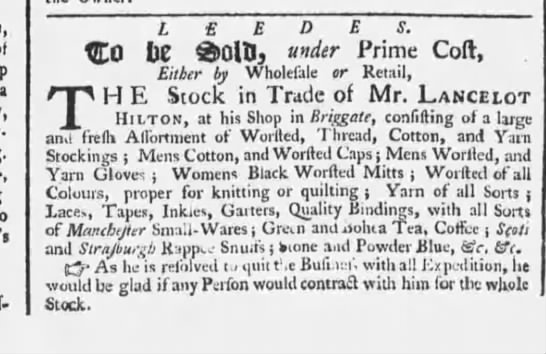
Worsted caps, black worsted mitts and worsted and yarn gloves 1758 England -
The South-Carolina Gazette Charleston, South Carolina 10 Dec 1764 •  Page 4

Worsted, thread, cotton and yarn stockings imported along with black worsted mitts and yarn for knitting.  

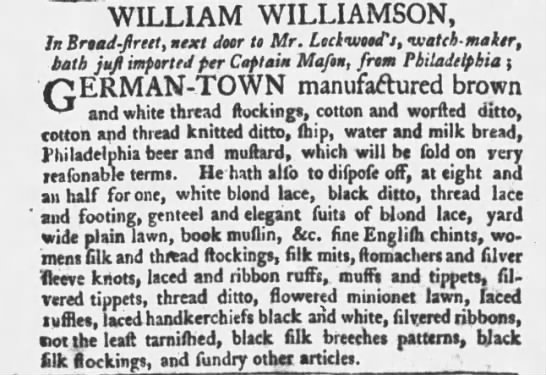
german town manufactured brown and white thread stocking and etc. 1767 -

The South-Carolina Gazette and Country Journal Charleston, South Carolina 
08 Dec 1767,•  Page 3

In my previous blog article, "Seeking Worldly Goods", Pennsylvania stockings were highly prized and it is evident in William Sample Alexander diary where family members requested stockings to be made in Philadelphia (mid 1770s).  So could one speculate that with Charleston importing these Germantown stockings, is what spurred the Alexander family to seek out these stockings?  Just a guess.

Teaching people to knit or making stockings for purchasing

A few advertisements

The Pennsylvania Gazette Philadelphia, Pennsylvania 30 Aug 1770, •  Page 6

 What I find interesting is that they wanted to set up shop in Wilmington, North Carolina in 1770.  Haven't been able to find any more about if this business succeeded in Wilmington or not.


The South-Carolina Gazette, Charleston SC; 9 August 1770 pg. 5


Margaret McIntire - teaches knitting, sewing, marking and washing 1770 in Dutch Town - SC -
The South Carolina Gazette and Country Journal (Charleston SC)- June 26 1770


I find this advertisement very interesting.  Keep in mind there were no commercial patterns for knitting unlike the early to mid 19th century were books are printed with various patterns.  So having some one teach you how to knit, is probably how most people shared information and pattern styles. Although it is from Charleston it clearly shows that there was a need by both white and black people to learn how to knit, sew, mark and wash clothing.  I think it is also note worthy that she is located in Dutch-Town section of Charleston.  I wonder if this where the German immigrants resided as there was influx of German indentured servants in the 1750s and 1760s.

Types of stockings listed in women's inventories 

So, what was common for women to have in their wardrobes for stockings?  We are in the south, it gets hot and humid in the summer and damp in the winter.  So what would be best?  Silk, thread, cotton, worsted and all of the above?  Within the estate records in North Carolina, 33 women have stockings listed as an item out of 92 estate records that have clothing listed.

The break down of the types of stockings goes like this:

Total of 102 pairs listed

49 listed as "stockings"
29 listed as "thread"
9 listed as "old"
6 listed as ""worsted"
5 listed as "silk"
2 or less
"Yarn", "Cotton", "Old Worsted", "Old Silk", "Blue" and "Womens"

The average number of stockings listed in a women's inventory is 3 pairs.
However some estates can skew the numbers such as the 1770 estate of Ann Carter she had 16 pairs of thread stockings listed (Onslow County NC).  And the 1740 estate of Mary Glouster  (who was a Quaker in Pasquotank County, North Carolina) had 8 pairs of stockings listed which were a variety of styles. (cotton, worsted, "stockings" and thread).  In some cases, there were a variety of stockings listed but usually they just list x pair of stockings.  

As for colors of stockings, unfortunately there is only one reference to a color associated with stockings.  Blue stockings were listed in the inventory of Rebecca Eborn of Hyde County in 1758, there is a reference to red stockings on a Irish runaway servant from New Bern in 1757.   Are colored stockings a mid-18th century fashion statement or were there more colors but we are yet to find them within the confines of what resources we have available online.

There is more to learn about imported and domestic knitted goods.  I hope these 2 blog articles have helped share some light on what was available in both North and South Carolina.