Showing posts with label SC advertisements. Show all posts

Monday, April 20, 2026

Dimity and HumHum Textiles

 With the warm weather soon to be arriving..... Light weight and white or off white colored textiles such as Hum Hum and Dimity can be found for clothing in the south.   Although light colored linens, printed cottons and chintzs were the more popular textile for gowns; hum hum and dimity do show up as an alternative textile.


"Textiles in America: 1650-1870" by Florence Montgomery pg. 220 - Indian dimities and figured dimities are shown on this page

Striped dimity from Burnley & Trowbridge (example from my dimity gown)

Dimity textiles

Evidence of Dimity being sold in the Carolinas shows up as early as the 1730s in Charleston. As seen listed here as "fine India dimitys"

The South Carolina Gazette, Charleston SC Jan  1738 pg. 3


While this advertisement the list both plain, figured and corded white dimities imported.   

Imported by the late Kenneth & Benjamin Michie -
The South Carolina Gazette January 1st 1750 pg. 4


While the vessel "Charming Nancy" has imported "India" dimity and printed dimity.  What is fantastic about this advert is the variety of summer textiles, white calicos, white chintz and then the dimities. 

The South Carolina Gazette, Charleston SC April 30 1750 pg. 2


North Carolina Gazette and Wilmington Weekly Post-Boy, Dec 29,1773 pg. 3


While in Wilmington, corded and flowered dimity is brought in via vessels from Bristol in late 1773.

So what is "dimity" used for in when constructing clothing items?   We see petticoats, gowns, as well for riding waistcoats and riding habit jackets and petticoats. 

The Public Advertiser; London England, May 30, 1772, pg. 3

The South Carolina Gazette, Charleston SC Jul 12, 1740 pg. 4

Then we see this advertisement for a lost "India "Dimity gown faced with fine chints in Charleston SC, 1740.   It makes you wonder what the chintz fabric was it white or cream color?  

In a search for "dimity petticoat" - it gave me 83 hits from 1730-1783 newspapers covering both England and the US.   Most of the accounts are from England but there were notices for ready made dimity petticoats in SC or dimity to be made into petticoats.  

Bordered dimitites for petticoats " The South Carolina Gazette and Country Journal, Charleston SC March 24 1772 pg 4


"Broad and Narrow figured dimity for petticoats";

The South Carolina Gazette, Charleston SC Jan 22 1756 pg.6 

Hum Hum textiles

Humhums or Hum Hum textiles are seen arriving in SC by the early 1740s and still available up until the 1780s.

The South Carolina Gazette; Charleston SC July 16,1763 p.2

White callicoes, chints and humhums along with India dimity are listed for sale in Charleston in 1763.  Normally hum hums and dimity are not listed together as textiles being sold but we do see it in this advertisement noted above.

The South Carolina and American General Gazette, Charleston SC; March 30, 1772 pg. 6

While this 1772 advertisement for the "Irish Linen Warehouse" in Charleston specifically names HumHums available for gowns along with plain, flowered, striped and check Muslins and then also printed linen and callico gowns available.  And the advertisement below lists "fine white humhums" for gowns also from 1772 Charleston South Carolina.

The South Carolina Gazette and Country Journal, Charleston SC May 12, 1772 pg 3


The only piece of hum hum clothing that I have found so far in the North Carolina is from an inventory from 1777 for Martha McKildo's estate of Edenton, NC where a "white 'hum hums' gown and petticoat" are listed and they were sold at the estate sale for 2 pounds and 1 shilling.


Sale of Estates 1745-1808, Chowan County, NC, Martha McKildo, April 2nd, 1777.


"Textiles in America: 1650-1870 by Florence Montgomery, pg 262

Although the textile description of Hum Hum is of a plain cotton cloth that was thick and stout in texture woven in Bengal.  Was hum hum considered a decent enough textile for summer weight gowns in the south?  I wonder since the hum hum gown and petticoat was worth 2 pounds and the 2 "old" callico gowns were only worth 1 pound and 12 shillings.  

Could we consider dimity being a more finer textile for summer wear versus hum hum?  Yet, in 1775, Hum-hums are available and sold as a variety of articles for the "summer season". 

The South Carolina and American General Gazette, Jun 2 1775 pg.1

Either textile would be a great addition to create a variety of summer clothing especially in the southern climates.   I haven't seen "hum-hums" available on the market for those reproducing 18th century clothing but "dimities" are available and are wonderful addition for summer time history clothing.

Saturday, January 24, 2026

Scottish Clothing: Bonnets, Scotch plaids and plaid stockings and other associated clothing in the Carolinas


National Galleries of Scotland - Artist David Allan

This article will be examining Scottish Clothing in the Carolinas prior to 1776.  Scottish dress whether it be knitted bonnets, plaid stockings, plaid coats, gowns and jackets are documented in the Carolinas. Inventories, newspaper advertisements help us understand what is available in the Carolinas (both North and South) during the period before 1776.  There are references to these textiles and accessories found post 1776 and that is something we can look into at a later point. 


I spoke about scotch bonnets in a previous blog article but for those who don't know, scotch bonnets are a knitted cap that is fulled by shrinking the woolen fibers to make it resistant to the weather.    These are usually noted as a "blue bonnet" in runaway ads or as a "scotch bonnet".  These were available for purchase as early as 1758 in South Carolina.  I do want to note that early North Carolina newspapers are not as easily available as the ones from South Carolina and the other colonies.

Scotch or Blue Bonnet references: 

The South Carolina Gazette, Charleston SC Friday October 20 1758


The advertisement lists imported goods from Scotland on the "Live Oak" vessel - a variety of Scotch and Irish textiles as well as Tartan or Scotch plaids and blue bonnets.


New Hanover County, North Carolina Original Estate Records, Ca. 1741-1942; Author: North Carolina. Probate Court (New Hanover County), North Carolina. 


This inventory is of Captain James McDonough's estate from New Hanover County, NC dated October of 1760.  At the bottom of the inventory it lists several clothing items including: 1 pr of silver knee buckles, 1 old shoe buckle, 4 cloaks, 1 hat and 3 bonnets.   My best guess that these are blue bonnets.   If someone reads this different, please let me know.


Imported Goods in the Carolinas


The South Carolina Gazette, Charleston, SC-March 19, 1763


Imported Goods on the "Little Carpenter" March 1763 - Robert Hogg Account Book - Southern Historical Collection, UNC-Chapel Hill, NC

6 Scotch Bonnets priced at 3/10 for a value of 1 pound 3 shillings.  Sold in Charleston, South Carolina in 1763 at their store.

Robert Hogg was a merchant who sold items both in Charleston, SC and Wilmington, NC.  His ledger books are at the Southern Historical Collection at UNC-Chapel Hill and only 1 of the many ledgers have been digitalized so far.  So much more information to be found for sure!

Runaway Advertisements:


The South Carolina Gazette, Charleston SC July 31, 1762


Runaway mulatto man named John from South Carolina with a variety of clothing but the most notable was a Scotch bonnet and the implication that he will pretend to be "free."


The North Carolina Weekly Gazette, New Bern NC Dec 24, 1773


Runaway Advertisement noting of a runaway enslaved man named "Shie" from Anson County, North Carolina wearing a "Scotch" bonnet and a Dutch blanket.  Anson County is located near the NC/SC border and adjacent to Cumberland County as well.


Plaid stockings


NC Gazette and Wilmington Weekly Post-Boy, Wilmington NC Feb 26, 1766 pg.3


This is the only account that I have found of plaid stockings in North Carolina or for all the Carolinas.  Imported goods from Leith and Glasgow in February of 1766 to be sold at William Watkins store in Wilmington, NC.   Scotch plaid and plaid stockings are listed for sale.   We can find references to plaid stockings available in Virginia as early as the 1750s particularly on runaways and then for sale in the 1770s but this seems to be the only reference so far for the Carolinas.  


Scots Plaids or Tartans


They can be found imported into South Carolina from 1734-1775 and then into North Carolina per the 1750s-60s.   Here are a few references to them as textiles and as clothing items.


We find a runaway enslaved woman named Bella in South Carolina wearing a "scotch plaid" gown in the 1740s. 

The South Carolina Gazette, Charleston, SC March 8 1740 pg.3


The SC and American General Gazette, Charleston SC October 14, 1768 pg.3

We have a runaway advertisement from Charleston in 1768 of a woman named Hannah who is listed as wearing an "old plaid jacket" ozenbrig petticoat.


In the estate of Aller/Eller McKeller in Cumberland County, NC 1769 - list 2 yards of Green Tartan, another 1 1/4 yd of Green tartan purchased as well as 1 green coat.  

Account record for the estate of Aller McKeller, Cumberland County, NC November 1768
Estate records of Cumberland County - Estates Records, McInnish, Donald-McKinnon, Murdock, 1663-1978


In the sale of John Curry's estate in 1771 we see several pieces of clothing including 1 tartan coat which was worth 1 pound and 4 pence. 


Sale of John Curry's estate in 1771; Cumberland County, NC; Notes: Estates Records, Collins, John Henry-Denning, Martin D, 1663-1978 


Does these findings give us some answers?  I hope so.   They do give us a glimpse of what was available for those living in the Carolinas prior to 1776.   I can't think of any witty comments or conclusions to this blog post.   I will conclude with one final newspaper clipping describing the clothing on some "Scotch Torries" who broke out of a jail in Maryland after the battle of Moore's Creek in December 1776.

The Virginia Gazette, Williamsburg, VA Feb 7 1777 pg.2


Kenneth McDonald, Alexander McCleod, Daniel McCleod and Murdoch McCastle; were listed as four Scotch Tories from North Carolina.  Three of the men had on blue jackets while Murdoch had on a green coat.   Does the color of the jacket/coat signify anything of importance for Scottish people?  Just food for thought.

Hope you enjoyed this latest post!  


Thursday, November 12, 2020

Imported and domestic knitted goods (Part Two)

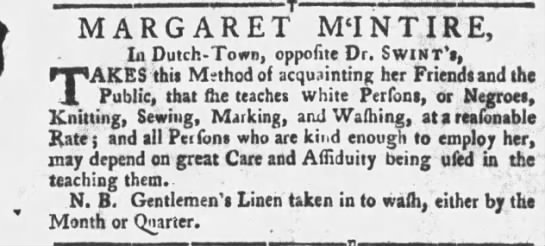
Margaret McIntire - teaches knitting, sewing, marking and washing 1770 in Dutch Town - SC -
The South Carolina Gazette and Country Journal (Charleston SC)- June 26 1770

Part Two of my research for imported and domestic knitted goods, I examine the types of knitting needles listed among inventories, invoices and store ledgers; how common were yarn stockings and finding advertisements to teaching people how to knit.  Also the types of stockings listed in women's inventories in North Carolina.

I am sure not the entire population of women during the 18th century knew how to knit.  It was a cottage industry in many areas of the world.   So the myth that everyone knitted or made their own stockings or knitted goods, is well untrue.  Ready made goods were available and imported from overseas or even within the colonies, there are advertisements posted to teach others how to knit and knitting needles were imported and sold in stores.  I don't find darning eggs listed in among items in women's inventories or as a ready made good/item.  


Out of the hundreds of women's inventories, only four list knitting needles among their possessions.  There is a 1750 sale of a man's estate that list several pairs of knitting needles as well   I might need to revisit the inventories again to look into more detail but my earlier notes I did list them as something of interest as I am a knitter myself.  

The 1762 inventory of Sarah Collings in Pasquotank County, North Carolina lists yarn, 2 pr of "nitten" needles and half a stocking (underlined in blue).  What does 2 pairs of knitting needles mean?  Most knitted items were knitted in the round on 4 needles and then a 5th needle as the working needle.  So does this mean 10 knitting needles in total?  

"North Carolina Estate Files, 1663-1979," Pasquotank County; Collings, Sarah (1762); State Archives, Raleigh.

The 1763 estate of Ann Overman lists all of her wearing apparel and then knitting needles and a pair of scissors.  

The 1779 estate of Hannah Alexander (not Bradley as noted on the files - John Bradley was the executor of her estate and I feel that there was an error on the outside of her estate file) from Mecklenburg County North Carolina lists several pairs of knitting needles, blue yarn, stockings and yarn and etc.

The final women's inventory that lists knitting needles is the 1744 estate of Elizabeth Hanner from Chowan County, North Carolina.  Oddly enough, she has 100 "nitten" needles listed in her estate.  It is unclear if she had a store in Chowan County but to have 100 knitting needles is rare.  It is listed near the bottom of the page right after 5 yards of coarse plad.  I tried to make it as large as it could possibly be.   I could have cropped the inventory but I wanted to also share all of her fabulous items listed in her estate.  


1744 estate of Elizabeth Hanner
"North Carolina Estate Files, 1663-1979," Chowan County Hanmer, Elizabeth (1744); State Archives, Raleigh.


Then we come to the 1750 estate for William Burnitt of Edgecombe County, North Carolina, he had both brass and plain knitting needles listed.   What is interesting is that they list them as four "pare" of "nitten" needles.  Again, what does that mean?  Four needles in total or 20 needles?


I wondered about brass knitting needles but looking at the image that I used in the last article you can clearly see the knitting needles are a brass or yellow color.  Were these used for finer yarns versus your typical metal or iron knitting needles that were used for heavier woolen yarns?   The answer I do not know.  But I found it odd that brass knitting needles were available and we know they were here in North Carolina as well as in South Carolina during the 1700s.

Jean Baptiste-Greuze (1724-1805) - Knitter Asleep

Store inventories and invoices of imported goods also provide us a clue of the commonness of knitting needles.  Were they brass, metal or both?  

The store sale of William Whitehead in Edgecombe County, North Carolina in 1750 lists the sale of several pairs of knitting needles. 


They do not denote if they are brass knitting needles or not.  They are sold as 4 prs. of needles.

The 1750 sale of the store owned by Major Joseph Howell in Edgecombe County also lists knitting needles but 3/4th knitting needles.  


Then we have the invoices for imported knitting needles into Charleston, SC in the early 1760s.  
 The vessel "Little Carpenter" brought in a variety of imported goods including iron and brass knitting needles.

Imported iron and brass knitting needles, in the Robert Hogg Account Books, #343, Southern Historical Collection, The Wilson Library, University of North Carolina at Chapel Hill.


Knitting needles versus knitting pins


I have found 2 early citations of "knitting pins" both are in Pennsylvania but it seems that this terminology falls out of favor and return again by the late 1770s this time surfacing in South Carolina.  I don't see the term "knitting pins" in North Carolina until 1787 in a newspaper in New Bern. I had wondered if it was a typo in the newspaper where they were missing a comma between knitting and pins but  Could knitting pins refer to a different type of knitting needle or again just a regional terminology?   I did search in foreign newspapers and the term "knitting pins" shows up post-1811 in England, Wales, Ireland and Scotland.  So for the most part, I would call them knitting needles for the majority of the 18th century.


Ready made or imported stocking advertisements


The North-Carolina Weekly Gazette New Bern, North Carolina 13 Mar 1778  •  Page 3


Woolen, thread and silk stockings imported from France into North Carolina during the American Revolution. 1778.  There are several advertisements for French imported goods during this period coming into North Carolina. 
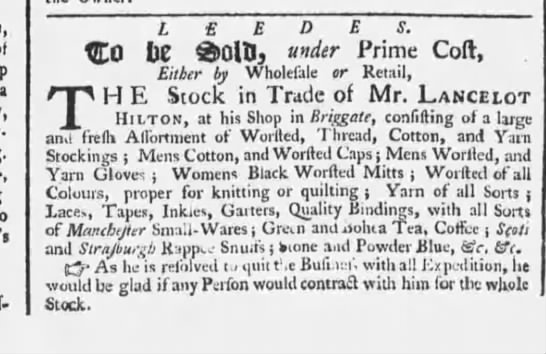

Worsted caps, black worsted mitts and worsted and yarn gloves 1758 England -
The South-Carolina Gazette Charleston, South Carolina 10 Dec 1764 •  Page 4

Worsted, thread, cotton and yarn stockings imported along with black worsted mitts and yarn for knitting.  
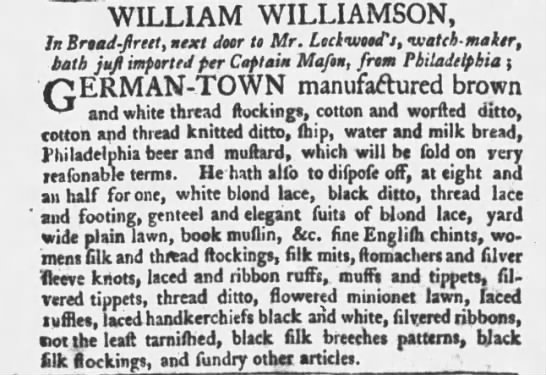
german town manufactured brown and white thread stocking and etc. 1767 -

The South-Carolina Gazette and Country Journal Charleston, South Carolina 
08 Dec 1767,•  Page 3

In my previous blog article, "Seeking Worldly Goods", Pennsylvania stockings were highly prized and it is evident in William Sample Alexander diary where family members requested stockings to be made in Philadelphia (mid 1770s).  So could one speculate that with Charleston importing these Germantown stockings, is what spurred the Alexander family to seek out these stockings?  Just a guess.

Teaching people to knit or making stockings for purchasing

A few advertisements

The Pennsylvania Gazette Philadelphia, Pennsylvania 30 Aug 1770, •  Page 6

 What I find interesting is that they wanted to set up shop in Wilmington, North Carolina in 1770.  Haven't been able to find any more about if this business succeeded in Wilmington or not.


The South-Carolina Gazette, Charleston SC; 9 August 1770 pg. 5


Margaret McIntire - teaches knitting, sewing, marking and washing 1770 in Dutch Town - SC -
The South Carolina Gazette and Country Journal (Charleston SC)- June 26 1770


I find this advertisement very interesting.  Keep in mind there were no commercial patterns for knitting unlike the early to mid 19th century were books are printed with various patterns.  So having some one teach you how to knit, is probably how most people shared information and pattern styles. Although it is from Charleston it clearly shows that there was a need by both white and black people to learn how to knit, sew, mark and wash clothing.  I think it is also note worthy that she is located in Dutch-Town section of Charleston.  I wonder if this where the German immigrants resided as there was influx of German indentured servants in the 1750s and 1760s.

Types of stockings listed in women's inventories 

So, what was common for women to have in their wardrobes for stockings?  We are in the south, it gets hot and humid in the summer and damp in the winter.  So what would be best?  Silk, thread, cotton, worsted and all of the above?  Within the estate records in North Carolina, 33 women have stockings listed as an item out of 92 estate records that have clothing listed.

The break down of the types of stockings goes like this:

Total of 102 pairs listed

49 listed as "stockings"
29 listed as "thread"
9 listed as "old"
6 listed as ""worsted"
5 listed as "silk"
2 or less
"Yarn", "Cotton", "Old Worsted", "Old Silk", "Blue" and "Womens"

The average number of stockings listed in a women's inventory is 3 pairs.
However some estates can skew the numbers such as the 1770 estate of Ann Carter she had 16 pairs of thread stockings listed (Onslow County NC).  And the 1740 estate of Mary Glouster  (who was a Quaker in Pasquotank County, North Carolina) had 8 pairs of stockings listed which were a variety of styles. (cotton, worsted, "stockings" and thread).  In some cases, there were a variety of stockings listed but usually they just list x pair of stockings.  

As for colors of stockings, unfortunately there is only one reference to a color associated with stockings.  Blue stockings were listed in the inventory of Rebecca Eborn of Hyde County in 1758, there is a reference to red stockings on a Irish runaway servant from New Bern in 1757.   Are colored stockings a mid-18th century fashion statement or were there more colors but we are yet to find them within the confines of what resources we have available online.

There is more to learn about imported and domestic knitted goods.  I hope these 2 blog articles have helped share some light on what was available in both North and South Carolina.