Showing posts with label inventories and estate records. Show all posts

Monday, April 20, 2026

Dimity and HumHum Textiles

 With the warm weather soon to be arriving..... Light weight and white or off white colored textiles such as Hum Hum and Dimity can be found for clothing in the south.   Although light colored linens, printed cottons and chintzs were the more popular textile for gowns; hum hum and dimity do show up as an alternative textile.


"Textiles in America: 1650-1870" by Florence Montgomery pg. 220 - Indian dimities and figured dimities are shown on this page

Striped dimity from Burnley & Trowbridge (example from my dimity gown)

Dimity textiles

Evidence of Dimity being sold in the Carolinas shows up as early as the 1730s in Charleston. As seen listed here as "fine India dimitys"

The South Carolina Gazette, Charleston SC Jan  1738 pg. 3


While this advertisement the list both plain, figured and corded white dimities imported.   

Imported by the late Kenneth & Benjamin Michie -
The South Carolina Gazette January 1st 1750 pg. 4


While the vessel "Charming Nancy" has imported "India" dimity and printed dimity.  What is fantastic about this advert is the variety of summer textiles, white calicos, white chintz and then the dimities. 

The South Carolina Gazette, Charleston SC April 30 1750 pg. 2


North Carolina Gazette and Wilmington Weekly Post-Boy, Dec 29,1773 pg. 3


While in Wilmington, corded and flowered dimity is brought in via vessels from Bristol in late 1773.

So what is "dimity" used for in when constructing clothing items?   We see petticoats, gowns, as well for riding waistcoats and riding habit jackets and petticoats. 

The Public Advertiser; London England, May 30, 1772, pg. 3

The South Carolina Gazette, Charleston SC Jul 12, 1740 pg. 4

Then we see this advertisement for a lost "India "Dimity gown faced with fine chints in Charleston SC, 1740.   It makes you wonder what the chintz fabric was it white or cream color?  

In a search for "dimity petticoat" - it gave me 83 hits from 1730-1783 newspapers covering both England and the US.   Most of the accounts are from England but there were notices for ready made dimity petticoats in SC or dimity to be made into petticoats.  

Bordered dimitites for petticoats " The South Carolina Gazette and Country Journal, Charleston SC March 24 1772 pg 4


"Broad and Narrow figured dimity for petticoats";

The South Carolina Gazette, Charleston SC Jan 22 1756 pg.6 

Hum Hum textiles

Humhums or Hum Hum textiles are seen arriving in SC by the early 1740s and still available up until the 1780s.

The South Carolina Gazette; Charleston SC July 16,1763 p.2

White callicoes, chints and humhums along with India dimity are listed for sale in Charleston in 1763.  Normally hum hums and dimity are not listed together as textiles being sold but we do see it in this advertisement noted above.

The South Carolina and American General Gazette, Charleston SC; March 30, 1772 pg. 6

While this 1772 advertisement for the "Irish Linen Warehouse" in Charleston specifically names HumHums available for gowns along with plain, flowered, striped and check Muslins and then also printed linen and callico gowns available.  And the advertisement below lists "fine white humhums" for gowns also from 1772 Charleston South Carolina.

The South Carolina Gazette and Country Journal, Charleston SC May 12, 1772 pg 3


The only piece of hum hum clothing that I have found so far in the North Carolina is from an inventory from 1777 for Martha McKildo's estate of Edenton, NC where a "white 'hum hums' gown and petticoat" are listed and they were sold at the estate sale for 2 pounds and 1 shilling.


Sale of Estates 1745-1808, Chowan County, NC, Martha McKildo, April 2nd, 1777.


"Textiles in America: 1650-1870 by Florence Montgomery, pg 262

Although the textile description of Hum Hum is of a plain cotton cloth that was thick and stout in texture woven in Bengal.  Was hum hum considered a decent enough textile for summer weight gowns in the south?  I wonder since the hum hum gown and petticoat was worth 2 pounds and the 2 "old" callico gowns were only worth 1 pound and 12 shillings.  

Could we consider dimity being a more finer textile for summer wear versus hum hum?  Yet, in 1775, Hum-hums are available and sold as a variety of articles for the "summer season". 

The South Carolina and American General Gazette, Jun 2 1775 pg.1

Either textile would be a great addition to create a variety of summer clothing especially in the southern climates.   I haven't seen "hum-hums" available on the market for those reproducing 18th century clothing but "dimities" are available and are wonderful addition for summer time history clothing.

Saturday, January 3, 2026

Women's Clothing on the cusp of Revolution


 Guess who's back from a hiatus?  Your friendly history nerd, clothing geek and researcher....

Back in 2024, we had the 250th anniversary of the Edenton Tea Party which was a fun event to participate at - Got to be fancy with a chintz gown, big hair and such.   Anyhoo.....Things are starting to kick off this year with the 250th anniversary of two major events here in North Carolina - the battle of Moore's Creek and the Halifax Resolves. So thought this would be a good time to bring the blog back to life and share what I've been researching for the past few months.

So what are women wearing in the early to mid 1770s in North Carolina?  Checked, black and white silk bonnets, black silk hats, red, blue and green cloaks, calico gowns, striped gowns, white linen gowns, "short" gowns, quilted petticoats and etc.   I'll examine a few inventories and wills to show what women are wearing here in North Carolina prior to 1776.


Amelia Mott, 1771 New Hanover County, North Carolina

Inventory of Amelia Mott, 1771 New Hanover County, NC.  Source: New Hanover County, North Carolina Original Estate Records, Ca. 1741-1942; Author: North Carolina. Probate Court (New Hanover County), North Carolina. Superior Court (New Hanover County)

Amelia has the following items: 1 Caster hat, 1 red cloak, 1 black silk hat, 1 old striped gown, 1 calico gown, 1 green shirt coat (petticoat), 1 shift, 1 bedgowns, 1 blue quilted petty coat, 1 bed gown, 1 shift, 1 old check apron, 1 calico gown, 1 check apron, 1 pr of gloves, 1 white apron, 1 homespun gown, 1 striped blue gown, 1 white bed gown, 1 old shift, 1 apron, 1 apron.

I love that they give detail (of sorts) to the gowns, striped, calico, homespun and even a striped blue gown.  While her bedgowns are generic in listing though she does have a "white" bed gown. Also note the blue quilted petty coat.

Barsheba Jones, 1772 Johnston County, North Carolina

Will of Barsheba Jones, 1772 Johnston County North Carolina.  Source: Johnston County, North Carolina Wills; Author: North Carolina. County Court of Pleas and Quarter Sessions (Johnston County)

Then we move in land to Johnston County, North Carolina where I found this gem within the past few days and absolutely love it as Barsheba gives the following items to her daughter Margaret Smith:

  1 quilted petticoat, 2 shifts, 1 pr of shoes and shoe buckles, 1 pr of worsted stockings and garters, 1 cap and handkerchief, 1 checked apron, 1 checked bonnet, silver sleeve buttons, 1 pr of leather gloves and choice of all the gowns.   While the rest of her clothes to be equally divided amongst the rest of all her daughters.  You wonder what else did she have in her wardrobe?

You may have notice that I bolded the word checked bonnet.   Yep, checked bonnets are here in North Carolina.  This is probably the latest I have seen reference to them.  I wish they would have noted if the bonnet was made of silk or of linen.    

Mary McConnell, 1774 Guilford County, North Carolina


Now we move even further inland to Guilford County and we find the will of Mary McConnell dated November of 1774. So Mary leaves to her daughter Mary Blyne: one gown and petticoat, her cloak and one pair of best blankets.  She bequeaths to her one daughter Martha Leacky one petticoat, a wraper and some bed curtains, then to her younger daughter she gives her one of her gowns .   Then on the next page she lists:

Mary McConnell will, Guilford County, NC:  Wills, 1771-1943; Author: North Carolina. County Court of Pleas and Quarter Sessions (Guilford County) Notes: Wills, Vol A-B, 1771-1838

She gives Margaret McBride daughter to Francis McBride her corded poplin gown; she leaves her shoe buckles to her son and then Agnes the daughter of James Blayer receives her bonnet.    What exactly is corded poplin?  Is it safe to guess that maybe Mary is a Quaker?   I haven't found evidence of that yet but something to look into.


Dorothy Seares, 1774 Wilmington, North Carolina


Back at the coast and in Wilmington proper......Dorothy's inventory lists 1 green silk umbrella, then down below it lists: 1 calico gown, 1 white linen gown, 1 white apron, 2 white caps, 1 pr of silver shoe buckles, and 2 plain gold rings.   


Dorothy Seares, 1774 New Hanover County, estate record and sale. New Hanover County, North Carolina Original Estate Records, Ca. 1741-1942; Author: North Carolina. Probate Court (New Hanover County), North Carolina. Superior Court (New Hanover County)

In the sale of her estate, they list a gown and apron being sold at 17 shillings, 8 pence; while another gown is sold for 1 pound, 1 shilling - which gown was worth more?  The calico gown or the white linen?

Then we conclude with the records of two men's estates.  The 1775 estates of William Wooten in Hyde County, NC and Dr. James Ward of New Hanover County, NC.


Estate sale of William Wooten, 1775 Hyde County, NC.  Source: Hyde County, North Carolina Estate Records, 1735-1944

Being sold are the following items: 1pr of stays, 1 quilt (guessing quilted petticoat); 1 chintz gown, 1 apron, a capshen, 1 pr of sleeves, 1 gown, 1 hood, wearing apparel, and a gown body.

While Dr. James Ward has a few ladies' items in his inventory such as: 2 sprigged aprons, 1 silk gauze cap, 1 white silk bonnet, 1/2 yard of ribbon, 1 fan and 1 paper box. and 2 1/4 yards of striped lawn.  I'll probably go back to examine his estate in a later blog as he has a plethora of textiles and clothing.

Inventory of Dr. James Ward 1775 New Hanover County, NC.   New Hanover County, North Carolina Original Estate Records, Ca. 1741-1942; Author: North Carolina. Probate Court (New Hanover County), North Carolina. Superior Court (New Hanover County)

Thanks again for checking out my blog.   I hope you enjoyed these inventories and wills.   They let us have a sneak peek of the past and allow us to learn more.   Till next time.  Keep researching and always ask questions!

Thursday, November 12, 2020

Imported and domestic knitted goods (Part Two)

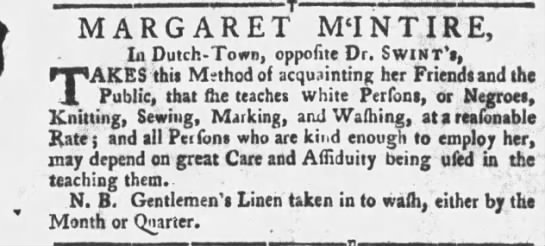
Margaret McIntire - teaches knitting, sewing, marking and washing 1770 in Dutch Town - SC -
The South Carolina Gazette and Country Journal (Charleston SC)- June 26 1770

Part Two of my research for imported and domestic knitted goods, I examine the types of knitting needles listed among inventories, invoices and store ledgers; how common were yarn stockings and finding advertisements to teaching people how to knit.  Also the types of stockings listed in women's inventories in North Carolina.

I am sure not the entire population of women during the 18th century knew how to knit.  It was a cottage industry in many areas of the world.   So the myth that everyone knitted or made their own stockings or knitted goods, is well untrue.  Ready made goods were available and imported from overseas or even within the colonies, there are advertisements posted to teach others how to knit and knitting needles were imported and sold in stores.  I don't find darning eggs listed in among items in women's inventories or as a ready made good/item.  


Out of the hundreds of women's inventories, only four list knitting needles among their possessions.  There is a 1750 sale of a man's estate that list several pairs of knitting needles as well   I might need to revisit the inventories again to look into more detail but my earlier notes I did list them as something of interest as I am a knitter myself.  

The 1762 inventory of Sarah Collings in Pasquotank County, North Carolina lists yarn, 2 pr of "nitten" needles and half a stocking (underlined in blue).  What does 2 pairs of knitting needles mean?  Most knitted items were knitted in the round on 4 needles and then a 5th needle as the working needle.  So does this mean 10 knitting needles in total?  

"North Carolina Estate Files, 1663-1979," Pasquotank County; Collings, Sarah (1762); State Archives, Raleigh.

The 1763 estate of Ann Overman lists all of her wearing apparel and then knitting needles and a pair of scissors.  

The 1779 estate of Hannah Alexander (not Bradley as noted on the files - John Bradley was the executor of her estate and I feel that there was an error on the outside of her estate file) from Mecklenburg County North Carolina lists several pairs of knitting needles, blue yarn, stockings and yarn and etc.

The final women's inventory that lists knitting needles is the 1744 estate of Elizabeth Hanner from Chowan County, North Carolina.  Oddly enough, she has 100 "nitten" needles listed in her estate.  It is unclear if she had a store in Chowan County but to have 100 knitting needles is rare.  It is listed near the bottom of the page right after 5 yards of coarse plad.  I tried to make it as large as it could possibly be.   I could have cropped the inventory but I wanted to also share all of her fabulous items listed in her estate.  


1744 estate of Elizabeth Hanner
"North Carolina Estate Files, 1663-1979," Chowan County Hanmer, Elizabeth (1744); State Archives, Raleigh.


Then we come to the 1750 estate for William Burnitt of Edgecombe County, North Carolina, he had both brass and plain knitting needles listed.   What is interesting is that they list them as four "pare" of "nitten" needles.  Again, what does that mean?  Four needles in total or 20 needles?


I wondered about brass knitting needles but looking at the image that I used in the last article you can clearly see the knitting needles are a brass or yellow color.  Were these used for finer yarns versus your typical metal or iron knitting needles that were used for heavier woolen yarns?   The answer I do not know.  But I found it odd that brass knitting needles were available and we know they were here in North Carolina as well as in South Carolina during the 1700s.

Jean Baptiste-Greuze (1724-1805) - Knitter Asleep

Store inventories and invoices of imported goods also provide us a clue of the commonness of knitting needles.  Were they brass, metal or both?  

The store sale of William Whitehead in Edgecombe County, North Carolina in 1750 lists the sale of several pairs of knitting needles. 


They do not denote if they are brass knitting needles or not.  They are sold as 4 prs. of needles.

The 1750 sale of the store owned by Major Joseph Howell in Edgecombe County also lists knitting needles but 3/4th knitting needles.  


Then we have the invoices for imported knitting needles into Charleston, SC in the early 1760s.  
 The vessel "Little Carpenter" brought in a variety of imported goods including iron and brass knitting needles.

Imported iron and brass knitting needles, in the Robert Hogg Account Books, #343, Southern Historical Collection, The Wilson Library, University of North Carolina at Chapel Hill.


Knitting needles versus knitting pins


I have found 2 early citations of "knitting pins" both are in Pennsylvania but it seems that this terminology falls out of favor and return again by the late 1770s this time surfacing in South Carolina.  I don't see the term "knitting pins" in North Carolina until 1787 in a newspaper in New Bern. I had wondered if it was a typo in the newspaper where they were missing a comma between knitting and pins but  Could knitting pins refer to a different type of knitting needle or again just a regional terminology?   I did search in foreign newspapers and the term "knitting pins" shows up post-1811 in England, Wales, Ireland and Scotland.  So for the most part, I would call them knitting needles for the majority of the 18th century.


Ready made or imported stocking advertisements


The North-Carolina Weekly Gazette New Bern, North Carolina 13 Mar 1778  •  Page 3


Woolen, thread and silk stockings imported from France into North Carolina during the American Revolution. 1778.  There are several advertisements for French imported goods during this period coming into North Carolina. 


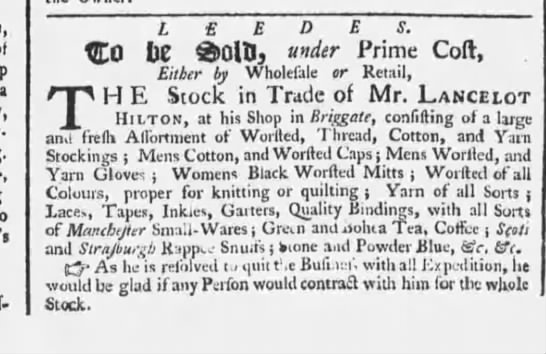
Worsted caps, black worsted mitts and worsted and yarn gloves 1758 England -
The South-Carolina Gazette Charleston, South Carolina 10 Dec 1764 •  Page 4

Worsted, thread, cotton and yarn stockings imported along with black worsted mitts and yarn for knitting.  

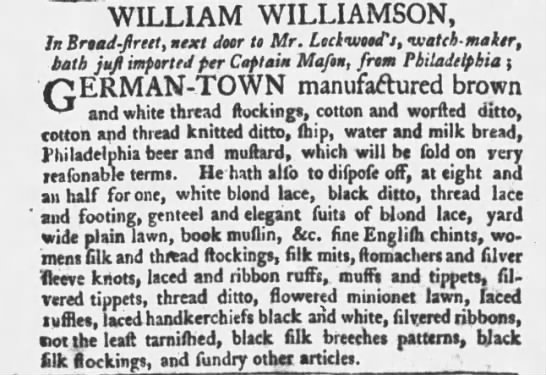
german town manufactured brown and white thread stocking and etc. 1767 -

The South-Carolina Gazette and Country Journal Charleston, South Carolina 
08 Dec 1767,•  Page 3

In my previous blog article, "Seeking Worldly Goods", Pennsylvania stockings were highly prized and it is evident in William Sample Alexander diary where family members requested stockings to be made in Philadelphia (mid 1770s).  So could one speculate that with Charleston importing these Germantown stockings, is what spurred the Alexander family to seek out these stockings?  Just a guess.

Teaching people to knit or making stockings for purchasing

A few advertisements

The Pennsylvania Gazette Philadelphia, Pennsylvania 30 Aug 1770, •  Page 6

 What I find interesting is that they wanted to set up shop in Wilmington, North Carolina in 1770.  Haven't been able to find any more about if this business succeeded in Wilmington or not.


The South-Carolina Gazette, Charleston SC; 9 August 1770 pg. 5


Margaret McIntire - teaches knitting, sewing, marking and washing 1770 in Dutch Town - SC -
The South Carolina Gazette and Country Journal (Charleston SC)- June 26 1770


I find this advertisement very interesting.  Keep in mind there were no commercial patterns for knitting unlike the early to mid 19th century were books are printed with various patterns.  So having some one teach you how to knit, is probably how most people shared information and pattern styles. Although it is from Charleston it clearly shows that there was a need by both white and black people to learn how to knit, sew, mark and wash clothing.  I think it is also note worthy that she is located in Dutch-Town section of Charleston.  I wonder if this where the German immigrants resided as there was influx of German indentured servants in the 1750s and 1760s.

Types of stockings listed in women's inventories 

So, what was common for women to have in their wardrobes for stockings?  We are in the south, it gets hot and humid in the summer and damp in the winter.  So what would be best?  Silk, thread, cotton, worsted and all of the above?  Within the estate records in North Carolina, 33 women have stockings listed as an item out of 92 estate records that have clothing listed.

The break down of the types of stockings goes like this:

Total of 102 pairs listed

49 listed as "stockings"
29 listed as "thread"
9 listed as "old"
6 listed as ""worsted"
5 listed as "silk"
2 or less
"Yarn", "Cotton", "Old Worsted", "Old Silk", "Blue" and "Womens"

The average number of stockings listed in a women's inventory is 3 pairs.
However some estates can skew the numbers such as the 1770 estate of Ann Carter she had 16 pairs of thread stockings listed (Onslow County NC).  And the 1740 estate of Mary Glouster  (who was a Quaker in Pasquotank County, North Carolina) had 8 pairs of stockings listed which were a variety of styles. (cotton, worsted, "stockings" and thread).  In some cases, there were a variety of stockings listed but usually they just list x pair of stockings.  

As for colors of stockings, unfortunately there is only one reference to a color associated with stockings.  Blue stockings were listed in the inventory of Rebecca Eborn of Hyde County in 1758, there is a reference to red stockings on a Irish runaway servant from New Bern in 1757.   Are colored stockings a mid-18th century fashion statement or were there more colors but we are yet to find them within the confines of what resources we have available online.

There is more to learn about imported and domestic knitted goods.  I hope these 2 blog articles have helped share some light on what was available in both North and South Carolina.  


Wednesday, February 20, 2019

The Art of Deciphering Historical Handwriting

Inventory of Mary Morris Pasquotank County, North Carolina
April 5th 1746


Cursive writing......for most historians, we can read and write it.   But before too long, there might be a generation of historians who will not understand or know how to read cursive handwriting.   I hope it does not become an lost art among historians and or the general public.

My first experience reading historical cursive writing was probably when I began helping my parents do genealogy research and looking at census records. (Yeah, I am nerd.)   Then off to college and began my journey in the Historic Preservation field where our "Intro to Local and Public History" aka HST 200 with Mr. Bob White.  This class weeded out those who would continue in the program.  We had to complete 3 projects that semester.  The one that sticks out the most was "find your dead person" in historical records.  So basically we were given a name of a resident in Cape Girardeau County prior to 1860 and we had to find all the primary historical records we could about him/her and then write a tour script for their "historical house."  This was way before the digital age, so we had to go to the courthouse and look up probate, wills, land transfer and estate records and then look on microfilm any census records.  Needless too say, I learned my mad research skills from that class.  Thanks Mr. White!!!!!!!

Deciphering historical cursive handwriting can be a challenge and even more so when the handwriting looks like chicken scratch and there are holes and tears in the paper such like the example of the one shown below.

Inventory of the estate of Elizabeth Winslow,  Pasquotank County, North Carolina
1750


There is also an art to deciphering what is been listed in the inventories.  Sometimes the administrator of the estate would write phonetically the articles of the inventory such as shows = shoes; jackgert/jackcoat = jacket; bunnet/bonett= bonnet; calyco = calico; pear= pair; sail=sale, fols = false, chex/chequex/check'd/check't = check; hude/hud = hood; shuebuckels = shoe buckles; cloke/cloake = cloak; linning = linen and etc.

Also terminology of clothing helps us understand what we are looking for:

18th century spelling/terminology = modern equivalent

Gound = gown
coats/pettecoats/pettycoats/petitcote = petticoats
pair of boddies/bodyes = stays
smocks = shift
sack & coat = French style gown and matching petticoat
quilts/ quilt coat = quilted petticoat


Rebecca Eborn sale of estate 1758
Hyde County, North Carolina

1 Garlick Shift
1 checked apron
1 checkered Bonit & Jacket
1 Calleco Gound
1 payr blue stockings
1 striped pettey coute
1 striped gound
1 chamber pott
1 ladel wooding
1 red clock
1 payr cambrick pinnors
1 blue silk bunit

So we decipher that there is:
1 garlix shift
1 check apron
1 check bonnet & jacket
1 calico gown
1 pair of blue stockings
1 striped petticoat
1 striped gown
1 chamber pot
1 wood ladle
1 red cloak
1 pr cambrick pinners
1 blue silk bonnet

What I like about Rebecca Eborn's inventory - she has both a blue silk bonnet and a check'd bonnet.  She is the first to have a check'd bonnet listed but it is not the only one that I find.  There is a calico bonnet listed earlier in 1753.  However, it does fall in line with other linen bonnets and or check'd bonnet.  I plan to go into more detail about bonnets in North Carolina for a future article.


Hannah Hay inventory: Carteret County, NC 1777

Hannah Hay's inventory shows us that in many cases they mix in other items amongst the clothing. So you have to pay attention because you think you have everything and then they throw an item towards the bottom.  Her inventory listed the following:

5 gowns, 4 silk handkerchiefs, 2 linen, 1 cotton ditto, 3 pettycoats, 2 jackets, 4 aprons, 3 hoods, 17 caps (yep, you read that right 17 caps!); 11 ribbons, 2 yds of white linen, 3 mantles, 1 iron trammel, 1 pr of pot hooks, 1 earthen porringer, some wool, 1 shoe hammer, 3 spoons, 2 gold rings, 3 sugar boxes, 1 looking glass, 3 hats, 2 bonnets, 1 glass salt seler[?], half bunch of tape, 1 silver buckle, 3 shifts, a few saddle nails and buckles, 3 prs of silver sleeve buttons, 43 rows of pins, 8 awls, 4 [unknown] half scaine of white thread, 3 stomachers.

 As you can see just from these two examples, sometimes they list the type of material/textile of the garment, sometimes they don't.  It doesn't deter or lessen the information.  It still provides us a number of garments or other items such as shoes, stockings, shifts and etc., that the woman owned.

I began a spreadsheet to breakout what I have found among women's inventories/wills and estate sales.  Here is my list of items:

gowns
short gowns
bed gowns
petticoats
jackets
Suite of clothes
wrappers/night rales
shifts
pr of stays
pr of stockings
pr of shoes
pr of gloves
bonnets
hats
handkerchiefs
cloaks
mantles
capuchin
hoods
aprons
prs of ruffles
caps
prs of pockets
stomachers
sleeve buttons
ribbons
gold rings/jewelry
garters
laces
shoe buckles
mitts

Again, I am still new to this blogging thing.  So if there is anything special you want to know more about (ie., types of bonnets, textiles, gowns, shoes, stockings and etc.) let me know.