Showing posts sorted by relevance for query bonnet. Sort by date Show all posts

Wednesday, February 20, 2019

The Art of Deciphering Historical Handwriting

Inventory of Mary Morris Pasquotank County, North Carolina
April 5th 1746


Cursive writing......for most historians, we can read and write it.   But before too long, there might be a generation of historians who will not understand or know how to read cursive handwriting.   I hope it does not become an lost art among historians and or the general public.

My first experience reading historical cursive writing was probably when I began helping my parents do genealogy research and looking at census records. (Yeah, I am nerd.)   Then off to college and began my journey in the Historic Preservation field where our "Intro to Local and Public History" aka HST 200 with Mr. Bob White.  This class weeded out those who would continue in the program.  We had to complete 3 projects that semester.  The one that sticks out the most was "find your dead person" in historical records.  So basically we were given a name of a resident in Cape Girardeau County prior to 1860 and we had to find all the primary historical records we could about him/her and then write a tour script for their "historical house."  This was way before the digital age, so we had to go to the courthouse and look up probate, wills, land transfer and estate records and then look on microfilm any census records.  Needless too say, I learned my mad research skills from that class.  Thanks Mr. White!!!!!!!

Deciphering historical cursive handwriting can be a challenge and even more so when the handwriting looks like chicken scratch and there are holes and tears in the paper such like the example of the one shown below.

Inventory of the estate of Elizabeth Winslow,  Pasquotank County, North Carolina
1750


There is also an art to deciphering what is been listed in the inventories.  Sometimes the administrator of the estate would write phonetically the articles of the inventory such as shows = shoes; jackgert/jackcoat = jacket; bunnet/bonett= bonnet; calyco = calico; pear= pair; sail=sale, fols = false, chex/chequex/check'd/check't = check; hude/hud = hood; shuebuckels = shoe buckles; cloke/cloake = cloak; linning = linen and etc.

Also terminology of clothing helps us understand what we are looking for:

18th century spelling/terminology = modern equivalent

Gound = gown
coats/pettecoats/pettycoats/petitcote = petticoats
pair of boddies/bodyes = stays
smocks = shift
sack & coat = French style gown and matching petticoat
quilts/ quilt coat = quilted petticoat


Rebecca Eborn sale of estate 1758
Hyde County, North Carolina

1 Garlick Shift
1 checked apron
1 checkered Bonit & Jacket
1 Calleco Gound
1 payr blue stockings
1 striped pettey coute
1 striped gound
1 chamber pott
1 ladel wooding
1 red clock
1 payr cambrick pinnors
1 blue silk bunit

So we decipher that there is:
1 garlix shift
1 check apron
1 check bonnet & jacket
1 calico gown
1 pair of blue stockings
1 striped petticoat
1 striped gown
1 chamber pot
1 wood ladle
1 red cloak
1 pr cambrick pinners
1 blue silk bonnet

What I like about Rebecca Eborn's inventory - she has both a blue silk bonnet and a check'd bonnet.  She is the first to have a check'd bonnet listed but it is not the only one that I find.  There is a calico bonnet listed earlier in 1753.  However, it does fall in line with other linen bonnets and or check'd bonnet.  I plan to go into more detail about bonnets in North Carolina for a future article.


Hannah Hay inventory: Carteret County, NC 1777

Hannah Hay's inventory shows us that in many cases they mix in other items amongst the clothing. So you have to pay attention because you think you have everything and then they throw an item towards the bottom.  Her inventory listed the following:

5 gowns, 4 silk handkerchiefs, 2 linen, 1 cotton ditto, 3 pettycoats, 2 jackets, 4 aprons, 3 hoods, 17 caps (yep, you read that right 17 caps!); 11 ribbons, 2 yds of white linen, 3 mantles, 1 iron trammel, 1 pr of pot hooks, 1 earthen porringer, some wool, 1 shoe hammer, 3 spoons, 2 gold rings, 3 sugar boxes, 1 looking glass, 3 hats, 2 bonnets, 1 glass salt seler[?], half bunch of tape, 1 silver buckle, 3 shifts, a few saddle nails and buckles, 3 prs of silver sleeve buttons, 43 rows of pins, 8 awls, 4 [unknown] half scaine of white thread, 3 stomachers.

 As you can see just from these two examples, sometimes they list the type of material/textile of the garment, sometimes they don't.  It doesn't deter or lessen the information.  It still provides us a number of garments or other items such as shoes, stockings, shifts and etc., that the woman owned.

I began a spreadsheet to breakout what I have found among women's inventories/wills and estate sales.  Here is my list of items:

gowns
short gowns
bed gowns
petticoats
jackets
Suite of clothes
wrappers/night rales
shifts
pr of stays
pr of stockings
pr of shoes
pr of gloves
bonnets
hats
handkerchiefs
cloaks
mantles
capuchin
hoods
aprons
prs of ruffles
caps
prs of pockets
stomachers
sleeve buttons
ribbons
gold rings/jewelry
garters
laces
shoe buckles
mitts

Again, I am still new to this blogging thing.  So if there is anything special you want to know more about (ie., types of bonnets, textiles, gowns, shoes, stockings and etc.) let me know.


Tuesday, May 12, 2020

Imported and domestic knitted goods (Part One)

Jean Baptiste-Greuze (1724-1805) - Knitter Asleep

Knitted goods both domestic and imported are seen in store inventories, personal inventories and on imported goods advertisements in the Carolinas.   Knitted or worsted caps, stockings, Scotch "bonnets" for men, mitts and mittens were the most common knitted items in the 18th century.  

For the love of god - please do not use Outlander as a historical resource for knitted or crocheted items. They are modern interpretations plus there were no crocheted items during the 18th century.  There were no knit shawls or sontags - those don't show until the 19th century for women. Crochet did not come around in popularity until the early to mid 19th century.   I highly recommend Mara Riley's patterns and also Sally Pointer.  If you are on Ravelry, they have patterns for sale there as well.   18th Century Material Culture page also a great resource for images of original items. 

Okay....back to our regular scheduled program.  

Scotch blue bonnets

"The North Carolina Weekly Gazette" New Bern, NC 24 December 1773

Anson county had many Scots-Irish settlers as well as New Hanover, Duplin, Bladen and Cumberland counties. Here is one example of a runaway enslaved person named SHIE from Anson County, North Carolina wearing a "scotch" bonnet.  

I have found several bonnets listed in inventories in New Hanover County such as James McDonough. Talking among other historians from North Carolina, we agree that these more than likely were blue "scotch" bonnets. 

"North Carolina Estate Files, 1663-1979,"  James McDonough, 1760; citing New Hanover County, North Carolina, United States, State Archives, Raleigh, NC


In Neill Buie's 1761 Cumberland County inventory, a bonnet (again more than likely a scotch bonnet) sold for 3 shillings, 4d.  It is underlined in blue.

"North Carolina Estate Files, 1663-1979,"  Neill Buie, 1761; citing Cumberland County, North Carolina, United States, State Archives, Raleigh 
Scots Bonnet- to order
Source: Sally Pointer
Example of plain scots bonnets or blue bonnet. 


Worsted Caps or Knit Caps


Particularly you see worsted caps or knit caps imported into the colonies and sold in stores.


Worsted, knit, milled caps are all seen being imported in the Colonies and including the Carolinas.  

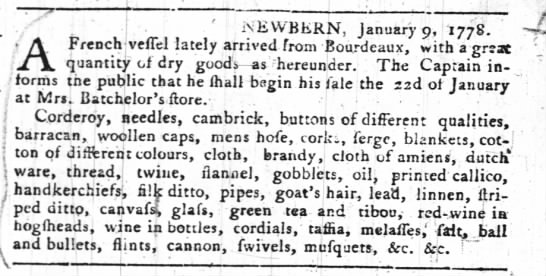
Imported French goods to be sold at Mrs. Batchelor's store 1778 -
North Carolina Weekly Gazette, New Bern NC
9 January 1778.

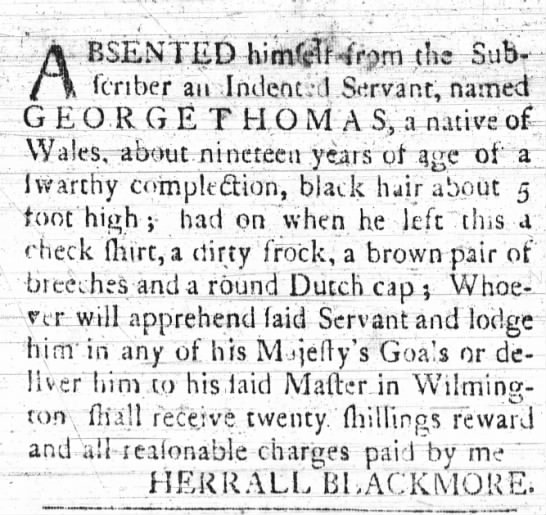
Runaway Welsh indented servant boy.  January 1773 -
The North Carolina Gazette, Wilmington NC
13 January 1773

mens blue mill'd caps 1768 SC -
"Mens blue mill'd caps" The South Carolina Gazette, Charleston SC
8 August 1768


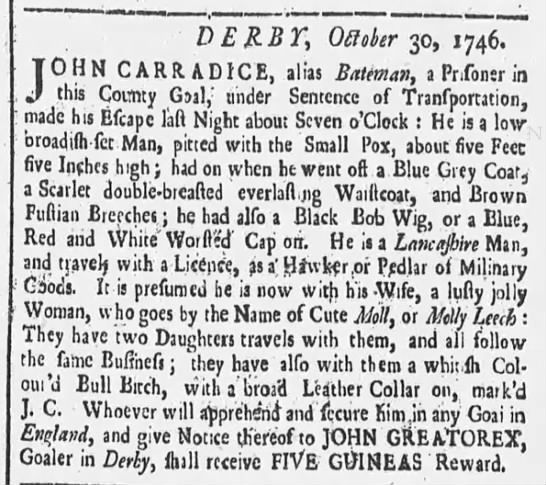
Blue, red and white worsted cap 1746 Derby, England -
The Derby Mercury, Derby Derbyshire, England
24 September 1746
Another variation of the woolen cap this one a blue, red and white worsted cap on.  A runaway prisoner for the County Goal in Derby, England.

This is my take on this cap.  Blue with red stripes and white at the edge


Stripe, scarlet and mill'd woolen caps 1763 SC -
The South Carolina Gazette, Charleston SC
12 November 1763
"Stripe, scarlet and mill'd woolen caps"


 Knitted goods whether imported or domestically manufactured were a part of the clothing of the men in the Carolinas.  Knitting needles are found in many store inventories as well as women's inventories sometimes with a stocking or mitten still on the needles.  Despite this, imported knitted goods were available to many people in the 18th century.  My next article will be on stockings, mittens, and knitting needles.  

I will close this part with a knitted cap that was found at Dry's Wharf at Brunswick Town/ Fort Anderson State Historic Site near Winnabow, North Carolina.  The photos are courtesy from Brunswick Town/Fort Anderson


Based off the archaeological findings, the cap dates from 1748.  My friend Hannah Smith wrote about the conservation work on it for her Master's Thesis, which I have linked here. 


There is some debate if this was a stocking that was altered to create a men's cap, or was this someone who was learning to knit and created this unique cap.

Saturday, January 24, 2026

Scottish Clothing: Bonnets, Scotch plaids and plaid stockings and other associated clothing in the Carolinas


National Galleries of Scotland - Artist David Allan

This article will be examining Scottish Clothing in the Carolinas prior to 1776.  Scottish dress whether it be knitted bonnets, plaid stockings, plaid coats, gowns and jackets are documented in the Carolinas. Inventories, newspaper advertisements help us understand what is available in the Carolinas (both North and South) during the period before 1776.  There are references to these textiles and accessories found post 1776 and that is something we can look into at a later point. 


I spoke about scotch bonnets in a previous blog article but for those who don't know, scotch bonnets are a knitted cap that is fulled by shrinking the woolen fibers to make it resistant to the weather.    These are usually noted as a "blue bonnet" in runaway ads or as a "scotch bonnet".  These were available for purchase as early as 1758 in South Carolina.  I do want to note that early North Carolina newspapers are not as easily available as the ones from South Carolina and the other colonies.

Scotch or Blue Bonnet references: 

The South Carolina Gazette, Charleston SC Friday October 20 1758


The advertisement lists imported goods from Scotland on the "Live Oak" vessel - a variety of Scotch and Irish textiles as well as Tartan or Scotch plaids and blue bonnets.


New Hanover County, North Carolina Original Estate Records, Ca. 1741-1942; Author: North Carolina. Probate Court (New Hanover County), North Carolina. 


This inventory is of Captain James McDonough's estate from New Hanover County, NC dated October of 1760.  At the bottom of the inventory it lists several clothing items including: 1 pr of silver knee buckles, 1 old shoe buckle, 4 cloaks, 1 hat and 3 bonnets.   My best guess that these are blue bonnets.   If someone reads this different, please let me know.


Imported Goods in the Carolinas


The South Carolina Gazette, Charleston, SC-March 19, 1763


Imported Goods on the "Little Carpenter" March 1763 - Robert Hogg Account Book - Southern Historical Collection, UNC-Chapel Hill, NC

6 Scotch Bonnets priced at 3/10 for a value of 1 pound 3 shillings.  Sold in Charleston, South Carolina in 1763 at their store.

Robert Hogg was a merchant who sold items both in Charleston, SC and Wilmington, NC.  His ledger books are at the Southern Historical Collection at UNC-Chapel Hill and only 1 of the many ledgers have been digitalized so far.  So much more information to be found for sure!

Runaway Advertisements:


The South Carolina Gazette, Charleston SC July 31, 1762


Runaway mulatto man named John from South Carolina with a variety of clothing but the most notable was a Scotch bonnet and the implication that he will pretend to be "free."


The North Carolina Weekly Gazette, New Bern NC Dec 24, 1773


Runaway Advertisement noting of a runaway enslaved man named "Shie" from Anson County, North Carolina wearing a "Scotch" bonnet and a Dutch blanket.  Anson County is located near the NC/SC border and adjacent to Cumberland County as well.


Plaid stockings


NC Gazette and Wilmington Weekly Post-Boy, Wilmington NC Feb 26, 1766 pg.3


This is the only account that I have found of plaid stockings in North Carolina or for all the Carolinas.  Imported goods from Leith and Glasgow in February of 1766 to be sold at William Watkins store in Wilmington, NC.   Scotch plaid and plaid stockings are listed for sale.   We can find references to plaid stockings available in Virginia as early as the 1750s particularly on runaways and then for sale in the 1770s but this seems to be the only reference so far for the Carolinas.  


Scots Plaids or Tartans


They can be found imported into South Carolina from 1734-1775 and then into North Carolina per the 1750s-60s.   Here are a few references to them as textiles and as clothing items.


We find a runaway enslaved woman named Bella in South Carolina wearing a "scotch plaid" gown in the 1740s. 

The South Carolina Gazette, Charleston, SC March 8 1740 pg.3


The SC and American General Gazette, Charleston SC October 14, 1768 pg.3

We have a runaway advertisement from Charleston in 1768 of a woman named Hannah who is listed as wearing an "old plaid jacket" ozenbrig petticoat.


In the estate of Aller/Eller McKeller in Cumberland County, NC 1769 - list 2 yards of Green Tartan, another 1 1/4 yd of Green tartan purchased as well as 1 green coat.  

Account record for the estate of Aller McKeller, Cumberland County, NC November 1768
Estate records of Cumberland County - Estates Records, McInnish, Donald-McKinnon, Murdock, 1663-1978


In the sale of John Curry's estate in 1771 we see several pieces of clothing including 1 tartan coat which was worth 1 pound and 4 pence. 


Sale of John Curry's estate in 1771; Cumberland County, NC; Notes: Estates Records, Collins, John Henry-Denning, Martin D, 1663-1978 


Does these findings give us some answers?  I hope so.   They do give us a glimpse of what was available for those living in the Carolinas prior to 1776.   I can't think of any witty comments or conclusions to this blog post.   I will conclude with one final newspaper clipping describing the clothing on some "Scotch Torries" who broke out of a jail in Maryland after the battle of Moore's Creek in December 1776.

The Virginia Gazette, Williamsburg, VA Feb 7 1777 pg.2


Kenneth McDonald, Alexander McCleod, Daniel McCleod and Murdoch McCastle; were listed as four Scotch Tories from North Carolina.  Three of the men had on blue jackets while Murdoch had on a green coat.   Does the color of the jacket/coat signify anything of importance for Scottish people?  Just food for thought.

Hope you enjoyed this latest post!  


Thursday, March 18, 2021

"Done with these Worldly Goods and a Posterity to bestow them upon" - Examining inventory records of New England versus Southern records


Recently I had a chance to look back at some genealogy work that I had done.  This time trying to find inventory records of my female ancestors which in some cases is hard to do.   Out of all my Germanic relatives, I have a sliver of ancestors who lived in the Colonies during the 1600 and 1700s.  So I had this brainy idea to compare my New England relatives with my southern ones, the ones living in Virginia mostly.   Needless to say if you are looking for Massachusetts records, good luck.  I found most of my records available in Connecticut via Ancestry.com.   So without finding any Virginia relatives records (at this current time), I am going to compare a couple of Connecticut inventories with some North Carolina inventories by years.  


We are starting with Susannah Knowlton Olcutt who dies in East Haddam, Connecticut in 1754  - she is my 8th great grand aunt.  So finding this inventory made me super happy.  Her husband, Cullick Olcutt (my uncle) died in 1732 right before the birth of their last son Benjamin. 


In 1754, she leaves her three children her worldly possessions, Thomas, Benjamin and Hannah.  Ironically, her daughter does not receive the bulk of her clothing, only a few items.  

Thomas receives the following clothing items: one silk crape frock; and one blew (blue) shaloon quilt (quilted petticoat?) and one Black bonnet.  

Benjamin receives one pare of stays and one gown and one pare of gloves and one white Holland apron; one lutestring hood, one piece of green plain cloth and one piece of black and blue plain cloth and one little trunk and one fan and six Holland caps … one linnen patecoat (petticoat).

While Hannah Olcutt Fisher only receives one linen shift and two woolen westcots (waistcoats); two aprons and two linen caps.

The items were appraised per the law direct in 1754.   The quilted petticoat, gown and bonnet was appraised at 3 pounds;18 shillings. And then other items such as the stays, quilt, one cote, aprons, shifts, waistcoats, handkerchiefs, silk hood are all listed and appraised. 
___________________________________________________________________________________

Then we look at the inventory of Hannah Charles of Perquimans County, NC.  Her probate is processed in 1753.   Not much is known about her but what makes her interesting is that she has jackets listed in her inventory.   It is a possibility that she was a Quaker since there were a large contingent of Quakers living in northeast North Carolina in the early 1700s. 


Estate Record of Hannah Charles, Perquimans County NC 1753


Hannah has 1 old camblet mantle, 1 old woolen jacket, 5 homespun petticoats, 1 cotton jacket, 2 pare of stockings, 1 stuff quilted petticoat, 3 homespun petticotes, 2 garlicks shifts, 6 aprons, 4 fine caps, 1 check'd handkerchief, a half yard of homespun, 1 pare of pockets, (further down) a pocket, 1 pormester hat, 1 basket and then finally 1 pair of linen gloves.

The thing to notice are two things, one the presence of jackets and the lack of bonnets in Hannah's estate.   The jackets are found in Quaker inventories in the northeastern part of North Carolina.  The lack of a bonnets strikes me but bonnets are found in the Carolinas.  Interestedly enough she has a a pormester hat which I am guessing is a straw or wool hat. 

___________________________________________________________________________________

Now we go back to Connecticut to look at the estate of Dr. Samuel Ely of Durham, CT; he dies in 1755.  Within his estate there are several pieces of women's clothing.  As much as we would like to only look for women's estate records, in many cases, we need to look at the spouses' estate records as well.   This is a possible relative but haven't been able to track down for certain.

Estate of Dr. Samuel Ely of Durham, CT, December 24 1755


Estate record of Dr. Samuel Ely of Durham, CT 1755


I love the variety of clothing listed in this inventory.  His wife was Sarah as listed in a previous document.  More than likely she died shortly before he did.  

1 pair of stays which was worth 1-6-8 (1 pound, 6 shillings and 8 pence) those are some expensive stays in the 1750s.  But we will look at those again in a little bit after doing a little bit of digging.

1 silk crape gown; 1 black and white chintz gown, 1 calico gown, 1 striped gown, 1 pr women's stockings, 1 pr ditto; 1 green skirt; 1 red cloak, 1 velvet hood, 1 muslin apron; 3 shifts; 1 lawn handkerchief, 1 holland ditto; 1 pair ruffles; 1 lawn cap; 1 lawn cap; 2 caps; 2 cap ribbons; 1 pr shoe buckles; 1 fan; 1 silk damask blanket; 1 pair gold jewels (earings?); 1 gold ring.

What I like about her inventory is the variety of gowns listed.  Silk, chintz, calico and a striped gown of unknown fabric more than likely linen I am guessing.  Also we see lawn being used as a textile for handkerchiefs, caps and then a muslin apron.  Little bits and pieces of textiles being used to elevate a person's status.  Not insanely rich but well off nonetheless.


Here is another version of the items listed in the inventory from another document.  It is attached to Dr. Ely's will.  Which I find interesting is that the stays are valued at a much lesser price of 26/8 (26 shillings, 8 pence). Also listed is what looks like a "hat" listed right before the lawn handkerchief.  This item was missing from the previous inventory taken.  And the striped gown is identified as being linen which helps us understand Mrs. Samuel Ely's wardrobe.

___________________________________________________________________________________

   Back in North Carolina....this time we examine the inventory of  Widow Rachel Mugaridge of New Hanover County from 1759.  More than likely, she lived in or near Wilmington, North Carolina. Here we see bed gowns and a "check" bonnet listed  among other items.  "Check" bonnets seem to definitely be a unique item in North Carolina.  The only other place that I  have found "check" bonnets listed is in Maryland, (1750s-60s) in runaway advertisements.  I have yet to find "check" bonnets mentioned anywhere else.


Inventory of Widow Rachel Mugaridge, New Hanover County, North Carolina 1759


What I find interesting about here inventory is that variety of clothing listed.  A silk gown, a calico gown along with 2 bedgowns.  Could the bedgowns considered a lesser item or a dress down item from the gowns, possibly.  Also are the "quilts" quilted petticoats?  They are listed alongside the "under petty coat", which again....what does that mean?


___________________________________________________________________________________


"Connecticut Journal" January 26, 1770 page 4


Here we see an advertisement for the estate of Sarah Granger, late of New Haven, Connecticut in 1770.  Again, a possible relative but haven't tracked her down yet.  Her inventory is interesting because we find a few things...


Above we see one stript gown old; one short gown? ; one quilt old shalloon? ; one quilt flannel old?; 2 old caps; one old sheet wore out and --- old check linen apron.


 Then on the 2nd page we see one old black silk hood and one old short cloak.   I would categorize her as a lower class person.  Her total estate was only worth 14 pounds.  What I find interesting is you don't see stays, shoes, shifts, hats or anything extra in her wardrobe.  I am guessing she was more than likely she was buried with them.
___________________________________________________________________________________

Next we examine the estate records of Sarah Wilson of Bertie County, North Carolina.  The inventory of goods and chattel were taken on March 20th 1770.  I had recently found this inventory while looking through some other records.   Bertie County is located in northeast North Carolina and was established as a county in 1739.   

Her inventory is interesting because she has 2 bonnets, a "permeter" hat, "shift's cloth" and a variety of other things too.   Of her bonnets, she has a white and a black bonnet listed.   Would the white bonnet be used in the summertime while the black bonnet is used during other times of the year?   


I like that the handkerchiefs are mentioned as either silk or just handkerchiefs.  You wonder if those 5 handkerchiefs were printed in some manner or not.  Again, another jacket is listed in her inventory.  I do not know if Sarah was a Quaker or maybe some other ethnic group. More to look into I suppose.  I love her inventory, I just wish there was more descriptions of her gowns and clothing but alas it's another story to look into.
___________________________________________________________________________________

And then my final inventory...Beluah Holmes of Woodstock, Connecticut.  She dies in 1778.  She was only 48 years old when she passed.  Her wardrobe is amazing.  She never married and her mother Hannah had died the previous August.  Again another possible relative but haven't traced it down for certain.  What I love about her inventory is the variety of clothing and that she has "short" gowns listed in her inventory but yet she is 48 when she passes away.  So does the rule that "short" gowns are only found on younger women seems a little bunk.   


She has 2 short gowns listed - a linen and a striped short gown. Again she is no spring chicken but what do short gowns exactly mean in the 1770-80s?  More goodies to dive into such as she has quilted petticoats, brown mitts, linen gloves, a black silk bonnet, cotton and linen stockings, and then the waistcoats.  Were the waistcoats used for informal wear like around the house instead of wearing stays?   She has 2 waistcoats and then a striped woolen waistcoat but she does have 1 pair of stays.  

 Oh her gowns.....
1 crimson silk & worsted; 1 purple and white chintz; 1 double wrapping? gown; 1 brown camblet gown; 1 white corded dimmothy (dimmty) gown.   What shocks me the most is that her cambrick apron was worth 42p which is almost the same price as one of her gowns.  I just love this inventory.  So many ideas for a woman to wear in New England in the late 1770s.  

Looking at inventories always gives me ideas for my impression.   Maybe I will recreate some of the items listed in the estate records of my relatives as my way of honoring them.   I am really loving the purple and white chintz gown....(Ideas are brewing).......

Thanks again for checking out my blog.   Till next time.  Keep researching and always ask questions!